
I just finished reading Democracy in Chains: The Deep History of the Radical Right’s Stealth Plan for America by Nancy McLean. This book was as creepy as anything Stephen King ever wrote, but it isn’t a horror novel or even fiction. It’s a well-researched expose of how America lost its way — and it started a lot earlier than you thought. It also wasn’t an accident. Everything up to and including public attitudes about democracy and the rightward shift of both parties was planned down to the smallest detail decades ago.
It all started innocuously enough with an ultra-conservative economist named James McGill Buchanan in the early 1950s. Buchanan was a libertarian who believed that the New Deal, labor unions, and the social safety net were assaults on true freedom (to him and others like him, “freedom” meant the right of property owners to keep all their wealth) and who also believed the Gilded Age — a time of terrible inequality and suffering harrowingly described in Upton Sinclair’s The Jungle) — was the last time America was on the right track.
Buchanan was relentless in his pursuit of the freedom of the wealthy and property-owning minority (who he saw as more deserving) over the masses of poor and middle class people who benefited from the social safety net, public education, labor unions, social security, and other programs put into place under the New Deal to alleviate the ravages of the Great Depression and improve life for almost everyone. He also didn’t believe that people who didn’t own property should have the right to vote, because they would tend to favor democracy over true “freedom” and therefore stood in the way of the growth of an unfettered free market.

James McGill Buchanan
The cancer on democracy began, like all cancers, with a tiny cell (and a lot longer ago than I ever imagined): Buchanan set off what would become a wholesale assault on democracy in his home state of Virginia in the early 1950s by attacking public education in his state. He wanted it to be abolished and replaced with private schools and vouchers (sound familiar?) But at the time, his ideas were so unpopular they had no chance of influencing the public and were dismissed as fringe or even crazy by both major political parties. Buchanan, unfazed, realized that stealth measures would be necessary for his ideas to see the light of day.
Over time, he and others like him (such as the Koch Brothers, libertarian billionaires who have funded many right wing causes and played an important role in our march toward fascism) set up right wing think tanks and found insidious ways to infiltrate the economics departments of colleges and universities, thus influencing those who studied economics and the students who graduated from these schools.
In a seemingly unrelated chapter, McLean describes the hostile 1973 takeover of Chile’s formerly socialist and democratic government by a far right wing dictator who destroyed all social programs, gutted public education and healthcare, abolished free and fair elections, ended the free press, and made dissent illegal. And not just illegal: many dissenters were tortured horribly before being killed, or mysteriously “disappeared.” The end justified the means — the end being total power of the few (the oligarchs) at the expense of the many. McLean’s inclusion of this chapter about a little-known South American country is relevant because not only did the situation in Chile (which lasted for 16 years — democracy has been restored) closely mirror the regime that is trying to do the same here in America, the Chilean coup was aided and abetted by Buchanan and his cronies — and funded by our government.
Realizing that his ideas would never be popular with the public, Buchanan (and later, the Koch Brothers and others) deliberately planned a stealth takeover, which included deliberate lying to the public, manipulation of the press, the gradual demonization of democratic values and the social safety net, and normalization of the callous and unthinkable. Although they hated Vladimir Lenin’s Marxist ideology, they loved his methods, and studied them to find out how they could use the same methods to destroy democracy and install an authoritarian oligarchy in its place (Steve Bannon is also a big fan of Lenin for the same reasons).
These men and their right wing think tanks came up with new ideas for indoctrinating the public through deceptive, incredibly Machiavellian measures that resulted in getting both parties to shift rightward, until eventually, their goals that would benefit the few and hurt many no longer seemed so unthinkable. They were able, through their machinations and manipulations, to deceive people into voting against their own best interests and erroneously believing government and regulations (laws that protect people and the environment from corporate excess) were the greatest evil we faced.
These men were not stupid. They were well aware how much human misery and suffering extreme unregulated capitalism and privatization, removal of the safety net, voter suppression, and oppression of dissenters would create. They saw what happened in Chile — and approved in spite of the vast human misery the extreme capitalist regime caused there. But to them, the end always justifies the means. If people suffer, they are necessary casualties of a system they believe is the only one that would reward and benefit only the deserving. Those who suffer deserve to suffer.
The changes, which had already been going on for over two decades, finally became noticeable in the late 1970s, as evangelical Christianity was co-opted by the far right, which began to infiltrate its theology. Using religion as a tool to reach the middle and lower classes, most of the South and Midwest could be duped into voting against democratic values and for those that benefited only the oligarchs. Shortly thereafter, Reagan was elected and the era of deregulation and tax cuts for the wealthy and corporations began — and is still going on to this day. But even Reagan proved to be a traitor to the cause when he refused to privatize Social Security, which is a long dreamed of goal and frighteningly close to success. His refusal to cooperate caused a deep rift in the Republican party between the moderates and the hardline conservatives. Reagan would be too liberal for today’s far right.
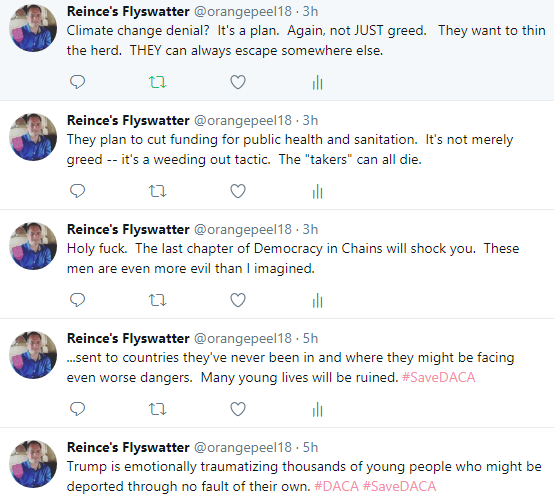
The most horrifying thing about Democracy in Chains is the last chapter, which describes our future if these sociopathic leaders have their way. I won’t go into too much detail here, but prepare to be shocked by these “liberty first” hardliners’ callousness for human and for all life. Such a future would make today’s seem like a paradise. Conditions would rival developing countries (and they are aware they would be but they don’t care). There would be no funds for public health or sanitation, which would cause pandemics only seen in the third world. The rich would live in gated palaces while the masses would be forced to try to survive in shantytowns and makeshift shelter, since housing would be priced out of their reach. No access to public education, transportation (roads would be privatized also), healthcare, or any basic services at all would create early death, brutality, despair and suffering, violent crime beyond anything we can imagine in America. Naturally, the lack of access to public schooling (and the need for cheap and slave labor) would lead to the dismantling of child labor laws (which they see as anathema to “freedom”). Private prisons with no laws against brutality would be the lot of many. There’s also a reason for their climate change denial. It’s not because they are ignorant (they aren’t) and it’s not solely about greed either. They actually see natural disasters as a way to weed out the “takers” (those who would not be able to prepare or escape) from the “makers.”
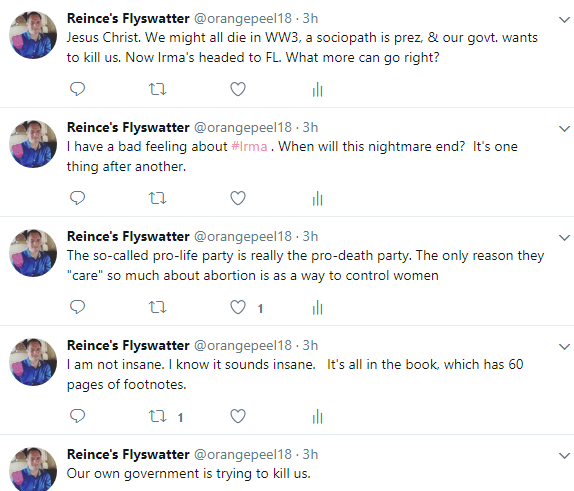
We are almost there. This coup is deliberate and well-organized and evil to the core — and is being carried out in the darkness and secrecy because there is no other way for them to force their diabolical plan on the rest of us. It didn’t begin with Trump, or Bush, or Clinton, or even Reagan. It’s been the stealth plan of the far right for almost 70 years. These people do their evil work in darkness and secrecy and the intent is to rewrite our Constitution to suit only themselves. They are determined to have their way no matter how antisocial or oppressive the means to get there might be. They are no longer even trying to hide their nefarious (if not outright evil) motives. This was evident during the recent healthcare bill fiasco, in which the GOP worked in secrecy, without input from any Democrats or progressives, and never even denied their lack of transparency. Trump is a late stage symptom of this coup and this book is a last minute call to action before it’s too late and we lose even our right to vote or protest. This is an unsettling but necessary book.
Democracy in Chains is incredibly well researched, with 60 pages of footnotes. It’s not an easy read, but I recommend it to anyone who cares about democracy and wonders why America lost its soul.





 Lucky Otters Haven