Meet and Greet: 11/5/16

Autumn’s last gasp: day trip on the Parkway.

brp_1105_2

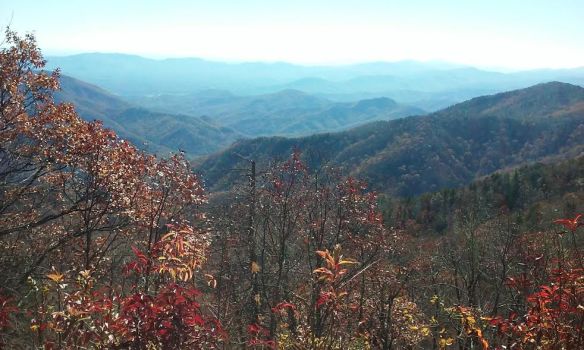
Looking up toward Craggy Dome, 6105 ft.

Down here in the southern Appalachians, the trees still have some color (a few are even still mostly green!)  I’m also happy to say that once October came, the trees seemed to be more colorful than they have been in the past several years.   Perhaps this was due to the very rainy July and August, followed by a very dry September.   It’s also been unseasonably warm (though not hot).  So I actually found myself appreciating Fall more this year.

This is my second drive along the Blue Ridge Parkway since fall started, and I’m happy to say the weather this time was much more pleasant than the last time.   This time I decided to drive north on the Parkway (last time we drove south, to Mount Pisgah),  with the intention of making it to the Virginia border.

But I got a very late start (it was almost 1:00 when I started out) and drove as far as I could to leave myself enough time to drive back before it got too dark.   I made it as far as the Blowing Rock/Boone area , which is about 120 miles north from where I live.

brp_1105_6

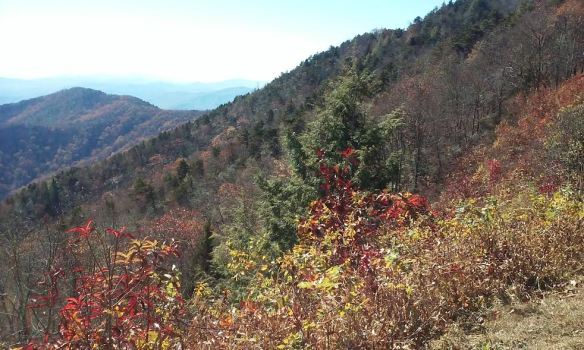
The parkway begins to climb when you enter the Black Mountains, on its way to Mount Mitchell, the highest peak on the East Coast.   I chewed gum to relieve the popping in my ears.  As you climb, the trees become shorter and scrubbier, almost like shrubs.  At that high an elevation, that’s as high as deciduous trees can grow.  Their short and slightly twisted stature helps them conserve energy and protects them from the high winds.  At that high elevation, the air is colder and the trees were completely winter-bare–except that many of these trees are sporting clusters of bright red  berries!    Craggy Gardens, several miles south of Mount Mitchell, is filled with wild evergreen rhododendrons and all those attractive red-berried small trees.

brp_1105

brp_1105_1

I had the radio on while I drove, and kept switching stations.   I settled on a country station that was playing this song about driving on backroads so I left it on and sang along while driving.

As you drive farther, you can see the rather sharp delineation (around 5,500 feet) where the conifers and fir trees (taiga zone) begin to take over from the last stunted deciduous trees.   That high up, the climate is too cold for even deciduous trees to survive.   At the tops of the peaks of the Black Mountain range, there are nothing but dark conifers, which gives the mountains the black appearance that inspired their name.    The starkness of the landscape this time of year gives it a primordial feel and you are stuck by just how ancient these mountains are (they are the oldest mountain range in the world: millions of years ago, they were as high as the Sierras).

brp_1105_4

Once you pass through the Blacks, the road descends and your ears start to  pop again.  For about 30 miles the landscape is pretty, but not that exciting.  There are a few spectacular views from the various outlooks, where people stop to take pictures or take a break from driving.   The deciduous trees took over again, but this far north, I noticed they were almost completely bare and did not show the color the trees farther south did.    I realized that even though I’d only driven about 70 or 80 miles by this point, I’d probably entered a more northerly “hardiness” zone.   The landscape had a decidedly more “northern” look even though I was still in North Carolina (and would be for some time, since I live very close to the South Carolina border).

brp_1105_5

I drove about another 50 miles and passed through another mountain range almost as high and impressive as the Blacks with a more rugged appearance (Linville Gorge Wilderness).  Grandfather Mountain is here,  just outside of Marion, and I remembered my son went on an Outward Bound expedition here as his 8th grade school trip and how much that experience seemed to change and mature him.   By this point I was picking up a rock station out of Winston-Salem, so I left that on for awhile.   I also found another station–an oldies station that plays only music from the 50s and 60s!  (I didn’t think those existed anymore!)

brp_1105_7

I kept driving, and the landscape leveled out again.   I passed through areas where you could actually see private homes and farms from off the Parkway (closer to where I live, the Parkway’s surrounded by the Pisgah National Forest, so you cannot see private homes or property from the road).   It looked like winter here, even though the temperature wasn’t that cold.   When I reached the Blowing Rock/Boone area, I decided it was time to turn around and go back.  It was already close to 3:30 and since I have such terrible night vision and knew it would be getting dark by 6 (we set the clocks back tonight, folks) that I could go no further.   My bladder was about to burst!  I stopped back at Craggy Gardens to pee, but had to use their Port-a-Potty because the visitor center was closed.

brp_1105_8

I arrived home just after sunset.   I love driving on the Parkway; it’s always so relaxing and spiritually uplifting, no matter what time of year I go.

13 reasons why being an introvert is awesome.

introvertsurvival

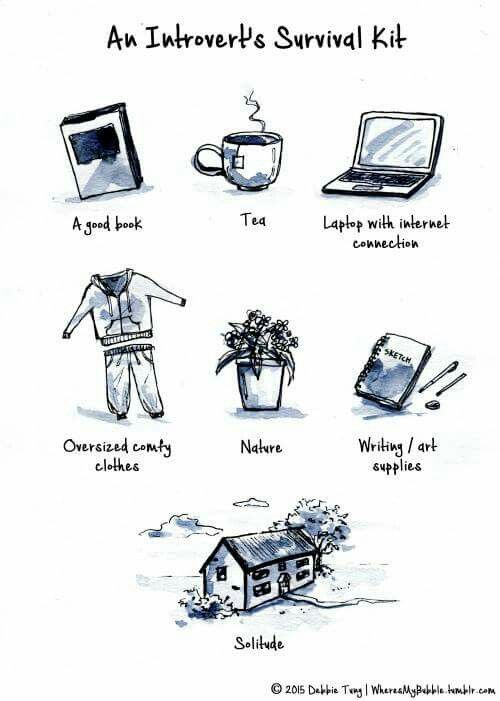
1.  You don’t have to spend a fortune on presents.

2.  You read more than the average person.

3.   You tend to be educated beyond your schooling, because you read so much.

4.   People think of you as smart and/or deep.  Because you’re self-educated from all that reading.

5.   You project an aura of mystery.  This can be sexy.  (It can also be creepy).

6.   You stay out of drama, or at least you try to.

7.   You tend to be able to see more than one side of a situation  because you’re always observing other people and you think so much and give yourself time to reflect.

8.   You have more insight into yourself and others.

9.   You appreciate nature.  This extends to animals.   As an introvert, you feel more in tune with living things if they’re non-human.  Beautiful scenery inspires you.

10.  You’re probably artistic.  Or musical.  Or literary.

11.   Your friendships, being fewer, tend to be deep and close ones.

12.  Once you have chosen someone as a friend, they can count on a friend for life.

13.  It’s hard for you to be bored, because you’re so good at being entertained all by yourself without the help of others.

“How to Spot a Collapsed Narcissist”

archie-bunker

The following is is a very interesting article I found on a site called  Flying Monkeys Denied, that explains how to identify a narcissist who has “collapsed” –in other words, a narcissist who has been denied adequate supply (leading to narcissistic injury), perhaps by having failed to meet his or her goals or obtain the admiration they thought was their due.    He (or she) will spiral into “pit bull” attack mode in their last ditch efforts to force others to provide them with supply.   They become hypersensitive, hateful, rage filled, tantrum throwing, angry, snappish, intolerant, and sometimes even violent.   Any pretense of niceness or charm they might have formerly displayed when things were going better for them disappears and the rage just underneath the mask of pleasantness comes out full throttle.

They still cannot accept any blame or criticism of themselves.    They project their self hatred onto the “targets” they have selected (people of another race, religion, ethnic group, gender, or people with a non-traditional lifestyle).  It’s as this level the narcissist displays bigotry and small-mindedness.   It’s at this level you see xenophobia and intolerance toward viewpoints outside their narrow worldview.   It’s at this level the collapsed narcissist may batter his wife or girlfriend so badly she winds up hospitalized or dead.

Archie Bunker in the ’70s hit TV show, “All in the Family” was a narcissist who was painfully aware he was at or very near the bottom rung of the socioeconomic ladder.   Fearing he’d sink to the even “lower level” of the minorities and various ethnic groups he looked down on with so much contempt, Archie hung onto that one thin thread of hope: his whiteness, his conservative values, and his blue-collarness.

There’s another narcissist in the public eye right now, similar to Archie Bunker in many ways (only with a lot more money),  who is running for president.  This narcissist also displays all the signs of having collapsed or being in the process of collapsing, perhaps due to the pressure of running for the highest office you can obtain but deep down knowing he really isn’t qualified, so he attacks those who question  his competence or criticize his agenda.   His bigotry, sexism and racism ensures that should he fail (lose the election, win the election but become the most hated president ever) he will still be “above” these other groups who he has deemed are beneath him.

The next stage in the narcissistic collapse (if getting supply through aggression, threats and intimidation fails) would be a descent into depression, suicide, or even psychosis (when a narcissist reaches this point of having hit rock bottom, they may become so desperate  as to voluntarily enter therapy, and this is when inroads into their psyche are most likely to be made).   Such a massive blow to the narcissistic ego could also result in complete loss of control  called “going postal.”   It is this possibility I think many of us sense in The Donald that makes his possible presidency so terrifying.    Should he collapse that far, he could start a nuclear war or turn America into a police state or order the extermination or deportation of all the groups of people he dislikes.  Gay people, people of color (particularly Muslim-Americans),  even women are at risk should that happen.

My apologies for applying Godwin’s Law,  but I believe this is how Hitler went from winning an election as a smooth talking populist who promised to “make Germany great again,” to the monster who became responsible for the extermination of 6 million Jews and other groups he disliked.   I could see this happening with Donald Trump all too easily.    There aren’t enough checks and balances any more to keep him at bay should he decide to unleash his narcissistic fury.   This is one angry and disordered man who is coming undone on national TV and I wouldn’t put anything past him.

I didn’t intend for this intro to be so long.   Here is the article I’m linking to:

How to spot a Collapsed Narcissist

My next step.

next_step

I’ve always wanted to write a book.   I actually did write a novel, back in 2003, but it sucked and was rejected by several publishers.    It didn’t take me too long to give up trying to get it published.

Today that novel sits in a cardboard box in the back of a closet.  It’s been sitting in that box for 13 years, its 300+ pages becoming brittle with age and the corners of the box  it dwells in now bent and taped together.  A few years ago I pulled out the typewritten pages and re-read the novel.   I cringed with embarrassment over how bad it was.  Not just bad, but atrocious.   It was shallow, self-indulgent, had no flow; was full of cliches, stilted dialogue,  and purple prose; and populated with unlikable, annoying characters.  It will probably never see the light of day again and most certainly will never be published.  But I still can’t bring myself to toss it out with the recycling.  If nothing else, it’s a reminder that I can finish something that I started.

I’ve done a lot of writing in my life, but that one shitty novel was my only attempt to write an actual book.   Although I’ve always wanted to write a book, it just seems so daunting.  I always find excuses:  it would take too long, I don’t have time, it wouldn’t be any good, I’m not really that good a writer, no one would read it, I’m bad with opening paragraphs, I’m bad with endings, I don’t have the money, I don’t have good ideas.

But excuses are just lies you tell yourself.   None of the aforementioned items have any truth to back them up.  I have a blog and a following, these days you can self-publish an eBook on Kindle at little to no cost (a print version can always come later), and after a year and a half of blogging, my writing has vastly improved.   Some days I have so many ideas for new posts that it makes my head spin.  I spend most of my free time writing anyway, so why am I not writing a book?  I really can’t think of any good reasons not to.

So I know what my next step must be.   I  haven’t yet decided whether I’ll do a compilation of my best or most popular posts, or write something from scratch.   I have a feeling I’ll go with the latter, but might incorporate a few of my blog posts into it.   I haven’t decided what my book will be about yet either, even though I do know it will be connected to this blog’s content in some way.

One thing that’s stopped me before is the thought of having to write hundreds of pages of prose.  But with an eBook or even if I self-publish a print version (which I think costs money but I’m not sure), I don’t have to write something that long.  I’ve read or reviewed a few books that were self published by bloggers, and few exceed 100 pages.

Another thing that makes writing a book seem like a chore is the lack of immediacy.   When you write a blog post, you get instant feedback.  Likes, comments, and views start coming almost from the minute you hit Publish.   You can monitor your stats after a very short time.   With writing a book, no one sees it until it’s published, and that could take a long time.   I’m not a patient person, and I hate having to wait for feedback.  But that doesn’t seem like a valid reason not to write one.

So all I have to do is make the choice to sit down and instead of opening up WordPress to write a new blog post, open up Kindle instead and write the first paragraph of my book.  I never thought I’d start a blog either, and one day I just decided to do it.   I think that’s how writing a book is going to work too.

When I do start to write, I will probably not be able to write new blog posts as often and might even have to take a break from it to concentrate on the book, but I’ll let everyone know when that happens.

Polydactyl cat house.

hairy_truman
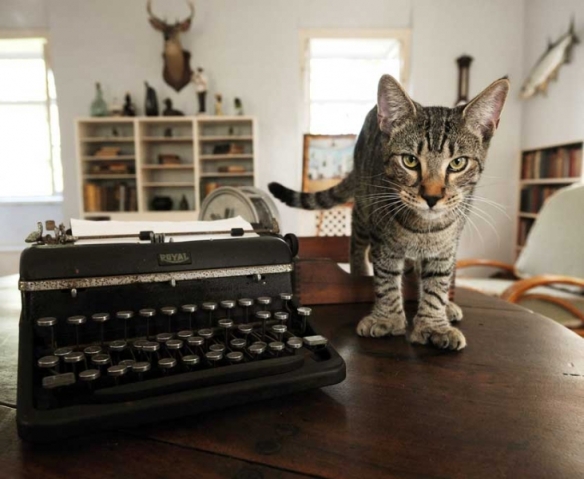
Hairy Truman, one of the feline residents of the Ernest Hemingway Home.

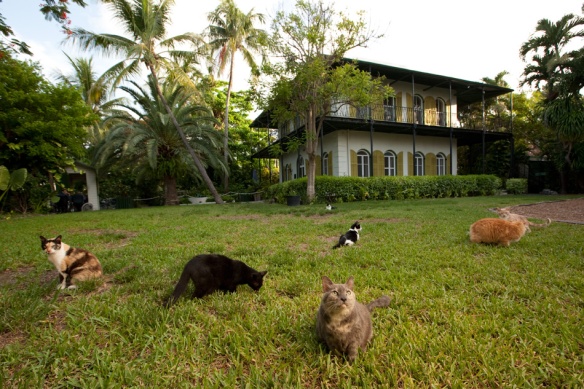
Someday I want to visit The Ernest Hemingway House in Key West, Florida.

It’s not because I’m a fan of Hemingway’s writings (though I am).   It’s not even because of the beautiful tropical landscaping and French Colonial architecture, which should be reason enough to see it.  The real reason I want to see this historical home is because of the large population of six- and seven-toed (polydactyl) cats that populates the island, the grounds, and the house itself.

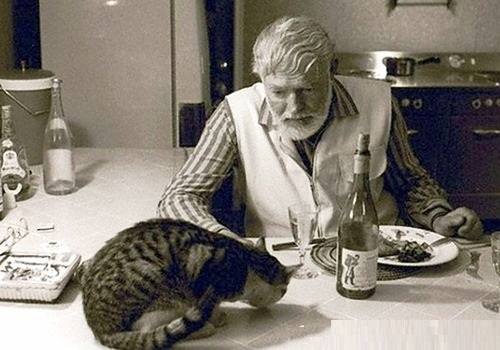
Like me, Ernest Hemingway loved cats, particularly polydactyl cats, and most or all of the cats are descendents of his beloved pet, a white polydactyl cat named Snow White, who was given to him by a ship’s captain.
hemingwayandcats

Ernest Hemingway with one of his cats.

The cats–which number about 40 or 50–are not feral; they roam the grounds freely, but they are mostly neutered or spayed (there is a limited breeding program to ensure the polydactyl population remains) and are well cared for by on-site veterinarians.   The cats are friendly and are so used to visitors they will come up and greet you or even walk with you.   Because Hemingway always named his cats after famous people, the cats are still given names of famous artists, writers, statesmen, and politicians.

Spending some time in the lush tropical gardens of this beautiful home, watching cats with six and seven toes mill all around and interacting with them, is my idea of heaven.

Where did Polydactyl cats come from?

hemingwaycat1

An unidentified Hemingway cat stares up into the lush foliage.

Polydactyl cats are not a breed; the extra toes are a mutation that is almost exclusive to the East Coast of the United States.    The first polydactyl cats discovered were some Maine Coon cats living in New England, who had more than the usual number of toes.   This is a common trait in Maine Coon cats, and actually helps them tread through snow more effectively.

But polydactyl cats aren’t limited to Maine Coon cats.    Polydactyls, like Hemingway’s Snow White, have always been popular as ship’s cats.   They are thought to bring good luck on the open seas, and their special paws make them excellent mousers.

The cats are now commonly referred to as “Hemingway cats.”

*****

The sad story of Boris. 

cat_hemingwayhome

Random cat relaxes on a table outside Hemingway Home.

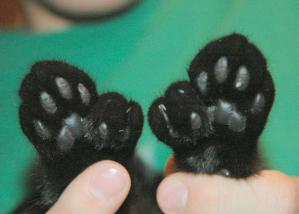
From 1994 to 1999, I had a beautiful brown tabby polydactyl cat named Boris.   He was long and lean and his extra toes made his feet look huge!  The sixth toe on each of his forepaws was opposable to his other toes, much like a thumb!  Boris actually used his big paws much like hands, and was actually able to grip objects in an almost human way, due to the “thumbs.”  The extra toes didn’t seem to interfere with his ability to jump, climb and get around.   It gave him a rather comical look.

Boris didn’t have 9 lives though.   He only lived about five years.    The problem began with his tail, which was long and whip-like.   It started with a break.   I’m not sure how his tail broke (he was an indoor/outdoor cat, so I’m thinking it might have gotten caught on something, possibly a tree branch) but one day I noticed it was hanging oddly in a kind of L shape.    Boris didn’t seem to be bothered by it but I knew it was time to take him to the vet. The vet confirmed his tail was broken and after taking x-rays, said it would not be possible to reattach the two tail parts, so Boris went into surgery to have the bottom part of his tail removed.

He came out of surgery and seemed fine, though now he had a stumpy tail no longer than about 3 inches.    We took care of his stump and changed his dressings regularly.  The vet said he seemed to be healing fine.

A few weeks later Boris seemed lethargic and wasn’t eating.  I took him back to the vet, who looked at his stump and noticed it seemed infected.   She put him on antibiotics and gave me an ointment to put on his stump.    But for some reason, the stump wasn’t healing properly.   The infection grew worse and Boris still wasn’t eating.

Another trip to the vet.   Boris would have to have his entire stump removed, and this would also include the removal of his penis (he was neutered so he had no testicles).   Boris came out of surgery and seemed to be recovering, but a week later he fell ill again.
polydactylpaw

Closeup of polydactyl paws.  This is a six toed example with “thumbs,” which is what Boris had.

Back to the vet again. Another round of antibiotics. After a few days, the infection still hadn’t gone away; it was now spread throughout his lower abdomen.   The vet couldn’t figure out why the antibiotics weren’t working and why the infection kept spreading.     We watched Boris for a few days and kept giving him the antibiotics but he just kept getting worse.

Finally, the vet told me sadly that she advised Boris be put down, since by now he was suffering — in pain, not eating, and barely conscious.  He couldn’t urinate because the opening where his penis had been was also infected and swollen nearly shut, and uric acid was building up in his system. She said there was nothing else she could do to save him.

Tears streamed down my face as she administered the shot, and I watched the life fade from Boris’ bright green eyes as I held onto his hand-like paws. The vet closed his eyes with her fingers and I kissed his toes.

I can’t find a photo of Boris right now (I know I have a few stashed away somewhere though), but he looked a good bit like “Hairy Truman” in the first photo.

I always wanted another polydactyl cat, but they are so hard to find.  Since they are not a breed, you basically have to wait until one pops up by chance at the shelter or rescue center.   I may never have another six-toed cat, but I’d love to spend some time with the dozens of six and seven-toed cats down in Key West someday.
hemingwaycatsoutside

7 Things You Didn’t Know About Clowns.

Clown Makes Funny Face

HAPPY HALLOWEEN!

Halloween just wouldn’t be Halloween without spooky clowns, right?

Mentalfloss lists 7 little known and interesting facts about this very old profession.

http://mentalfloss.com/article/87942/7-things-you-didnt-know-about-clowns

Depending on who you ask, clowns are either harmless fun or the stuff of nightmares. But no matter where your opinion falls, there’s a lot going on beneath the face paint of this surprisingly old profession. There’s even a story behind the iconic red nose: It can be traced to a member of the Fratellini family named Albert, who originated the Auguste clown archetype—complete with the world debut of the bright red clown nose. Now make like a clown car and stuff as many of these facts in your head as you can.

Read the rest of this post here.