Millennials are our only real hope for change.

Protestors sit in the street and demonst

Millennials, like all recent young-adult generations, have been demonized and denigrated by older generations. They have been called useless, dependent, entitled hipsters, and much worse.

But Millennials aren’t the first young adult generation to be regarded badly by their elders. Before them, back in the ’80s and ’90s (while Millennials were being born), Gen-Xers were dismissed by older generations as lazy, nihilistic, materialistic, uninvolved slackers. Before them, back in the ’60s and ’70s, Boomers were regarded as rebellious, hedonistic, disobedient troublemakers and “dirty hippies” who only cared about getting high and railing against the establishment.

Even the Silents, though largely ignored by older generations (because they tended to conform and obey when young, at least outwardly), were criticized for their “horrible and immoral music” (early rock ‘n roll) and the dancing that went with it.   But there were rebellious outliers even among young Silents:  the blue-collar “greasers” and college-educated Beatniks of the late 1950s and very early ’60s.

Returning to the Millennials, they have been called narcissistic, entitled, spoiled, and dependent on the parents who raised them well into their 20s and even 30s.

Let me correct a few things here.

Taking selfies is not narcissism. It’s a trend. In fact, studies have shown that true narcissists are less likely than others to post pictures of themselves online. Taking selfies may have something to do with vanity, but vanity doesn’t equal narcissism, although it may be a part of it.

Millennials are not entitled or spoiled. They are a generation that has not had the opportunities to achieve full adulthood, even if they attended college. Because of the dearth of good jobs for recent college graduates, or any decent jobs for high school graduates, many Millennials are forced to work at low paying McJobs that do not pay the rent and sometimes have to work 2 or 3 jobs just to make ends meet. For this reason, they often still live at home with their parents well into their 20s and sometimes even 30s.

Like all scapegoats, they are then blamed for their misfortunes, rather than the real culprit, which is a political system and an economy that will not allow them to get ahead in life. They look up at older generations, who had better opportunities in a nation where things were still affordable and where good jobs were still plentiful, and understandably, see how unfair it is.
bernie_atlanta

Millennials are called entitled and spoiled because they have taken to protesting and activism as a way to deal with what they correctly perceive as unjust, unfair, and outrageous. There is no reason why a college-, or even a high-school educated person should work harder and harder and still not be able to make a living wage. There is no reason why they should have to spend the better part of their adulthood paying back exorbitant student loans when all they can get is a job at a gas station or a fast food joint that barely pays enough to afford them the gas to get back and forth to said menial jobs. There is no reason why, like my son, they should be denied full-time hours just so their employer doesn’t have to pay them health insurance–and then be forced to take a second job to make the difference and still not be able to get health insurance because both are part-time.

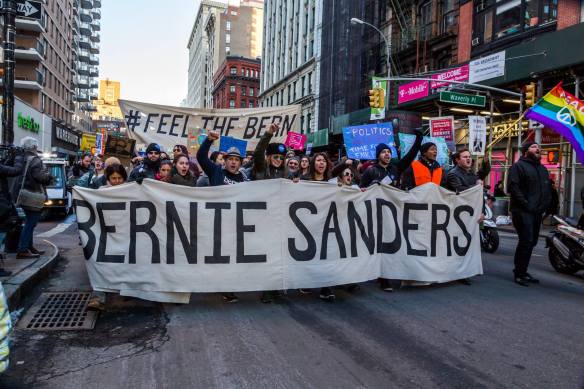
It is outrageous. If they didn’t protest and take to the streets I’d be worried about them. They are not backing down though; they refuse to be victimized by this sick system.

In 2011, we saw the first obvious indications that this generation was not going to be a bunch of fearful sheep and just put up with the status quo. With the Occupy Wall Street movement which spread like wildfire across the nation for a few short months until it was silenced by the Powers That Be, Millennials showed clear signs of heeding the words of Dylan Thomas instead:

Do not go gentle into that good night,
Old age should burn and rave at close of day;
Rage, rage against the dying of the light.

Though wise men at their end know dark is right,
Because their words had forked no lightning they
Do not go gentle into that good night.

Good men, the last wave by, crying how bright
Their frail deeds might have danced in a green bay,
Rage, rage against the dying of the light.

Wild men who caught and sang the sun in flight,
And learn, too late, they grieved it on its way,
Do not go gentle into that good night.

Grave men, near death, who see with blinding sight
Blind eyes could blaze like meteors and be gay,
Rage, rage against the dying of the light.

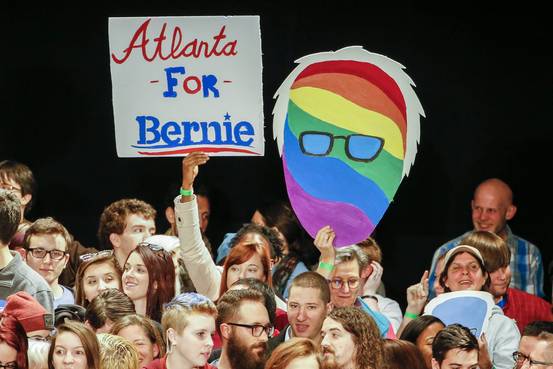
We saw it again in their almost rabid support of Bernie Sanders, a presidential candidate who represented those things that have been missing in American politics now for decades: empathy and generosity for all, a social safety net, a living wage, higher taxes for the wealthy and powerful, care and compassion for the vulnerable and disenfranchised. Sanders went surprisingly far in the primaries, nearly making it into the final two.

The first Millennials are thought to have been born in 1982 (though some sources put them as early as 1979).  The last Millennials were born in either 2000 or 2004 (depending on whose theories you believe), so not all of them were of voting age in this election. I believe if they had been, Sanders would have been the Democratic candidate instead of Hillary. Without the Millennial vote (and as a generation they are very likely to exercise that right, much more so than the Xers before them), I doubt that a candidate who proudly calls himself a democratic socialist (we need to get over the idea that “socialism” is a dirty word: it’s not communism and is a whole lot better than unbridled capitalism) would have gone as far as he did.
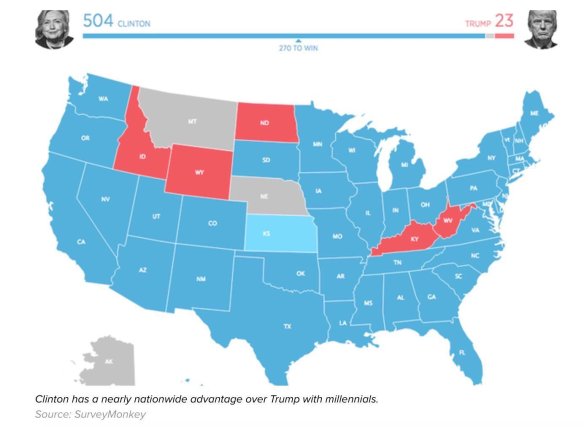
millennial_voting
How Millennials voted in this election.


Although Sanders ultimately lost out to Hillary, he still made a huge impact on not only the Millennial generation, but on the national zeitgeist in general. He did this mainly by making savvy use of social media, Twitter in particular. The overwhelming support for Sanders innoculated us all to the idea that it’s still possible that a true liberal (in the pre-1980s sense of the word) has a chance.

Now that Trump won the election, Millennials are rightfully outraged. They are not standing by idly wringing their hands and weeping, or cynically shrugging their shoulders as they say, “well, there’s nothing that I can do anyway.” No, instead, Millennials are protesting this election’s outcome. Trump is a man who can ruin their lives, and they have their whole lives in front of them. They are not going to just stand by and take it. They’re out on the streets protesting already, and are showing signs of the heroic generation they potentially are.

Way back in 1997, two Baby Boomers named William Strauss and Neil Howe wrote a book called The Fourth Turning.   I won’t describe the book in detail here; you will have to read it for yourself.  But it changed my entire outlook on history and on generations.   One of their theories is that history is not linear.   Generations (and history itself–historical “turnings”–as they are called) are cyclical.    The four generational “archetypes” and the four turnings repeat themselves approximately every 80 years, or the same length of time of a long human lifespan.   They correctly predicted that the Millennials would be a civically-involved, activist generation, even if what they envisioned was a slightly more conformist and conservative version of what they turned out to be.

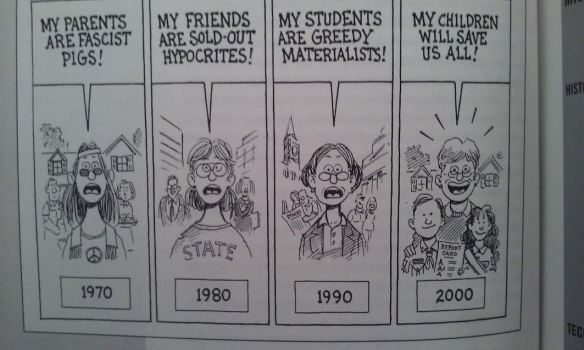
generational_cartoon
Credit: Millennials Rising, Strauss and Howe, © 2000.

The four generational archetypes are Prophets, Nomads, Artists, and Heroes.     The most recent Prophet generation is the Boomers (their predecessors were the Missionaries), who are born in a First Turning (a time of prosperity and conformity).    The current Nomads are the Gen-Xers (who correspond with the Lost Generation), who are born during a Second Turning (the most recent was the Consciousness Revolution, which took place in the ’60s and ’70s).   Artists would be the Silents, who are always born during a Crisis, or a Fourth Turning (the new Artists are still being born now).   The current Crisis began either in 2001 with 9/11, or 2008 with the housing crisis (the jury is still out on the start date).  Finally, Heroes are born during a Third Turning (the most recent one being the Culture Wars of the ’80s and ’90s), when individualism is high but institutions built during the First Turning are beginning to unravel.   The last generation of Heroes were the GI Generation, also fondly known as The Greatest Generation, who are remembered as our WWII heroes and the builders of the prosperous America of the midcentury.    Almost all of them have died off by now.  They have been replaced by the Millennials.

This may sound like hocus-pocus, but it’s not.   The overall character of each of the four generational archetypes is influenced by the turnings in which they were raised and came of age in, and the parenting styles of that particular turning.   In turn, the generational character combined with the life stages they happen to be occupying at a given time (what S&H calls “generational constellations”) both foments and influences each of the four turnings themselves.

Here’s how that works:

Generational Archetypes.

Prophets, born in a time of prosperity, conformity, and increasingly indulgent parenting, become self confident but by adolescence, they begin to rebel against the stultifying conformity, and set off an Awakening (Second Turning).  During young adulthood, they are experimental idealists.   As they rise to power during midlife, they have become vocal, highly opinionated, and passionate about whatever values they have adopted, leading us into a Third Turning (culture wars mentality).  They tend to be judgmental and engage in black and white thinking, convinced that only their way is the right one.  Prophets’ parents are usually Heroes or Artists.

Nomads, born in a time of questioning traditional values and changing social mores, are often neglected by their self involved parents who seem more interested in their own personal growth instead of them.  In reaction, they become self sufficient early on (latchkey kids), but become cynical and reach adulthood with collective low self-esteem.  They tend to distrust the system, which they regard as having failed them and of all generations, they are both the most conservative and least likely to be politically involved.  They care more about pragmatism and “just getting things done” than about values and ideals.   Their parents are usually Artists or Prophets.

Heroes, born in a time of institutional failure but increasing choices and the beginning of the cultural polarization of a nation,  are increasingly protected by their stressed-out parents (who perceive the world as more dangerous), and are encouraged to achieve great things but also tend to be micro-managed and overly controlled.   As they rise into adulthood, they realize the things promised them are not going to materialize, and take matters into their own hands to change the system to one that will work for them.  Their parents tend to be Prophets or Nomads.

Artists, born during a national Crisis, are overprotected (“helicopter parenting”) and strictly disciplined.    They are the children most likely to be told to be quiet, stay out of the way and not bother the adults, who are trying to deal with a dangerous world.   Artists tend to be obedient conformists until midlife, when they finally begin to rebel, often spurred on by the Prophets born right after them.   But caught between two more powerful archetypes (Prophets and Heroes), they tend to never take one side or the other, and learn to be sensitive peacemakers instead, concerned with checks and balances, and “reasonable”and “fair” policies that don’t make waves. They attempt to bring people together.  Their parents are Nomads and Heroes.

It’s interesting to note that no Artist has become President during the Millennial Cycle (the 80-year historical period we are currently still in), but Bernie Sanders, a textbook example of the Artist archetype, came awfully close.

It’s also interesting that a Crisis forms just as peacemaking Artists are at their lowest point of influence–when they are in early childhood and very old age.

Turnings.

The four turnings are approximately 20 year time periods encompassing a particular national mood, which is shaped by the generational attitudes and the age brackets they happen to be in at the time.   Whatever generation happens to be in their prime adult years (midlife) and in the most important leadership roles, tends to set the overall tone for the turning in question.

Thus,

A First Turning, with Heroes in midlife (and Artists as their helpmates), is concerned with institutional building, scientific advancement, prosperity for all, family life, and indulgent parenting.   There is a narrowing of the gap between the richest and the poorest.  Sex roles seem to be at their least ambiguous.  A first turning tends to be unconcerned with matters of a religious or spiritual nature, idealistic values, or social change.  The last First Turning we experienced were the prosperous post-war years, until Kennedy’s assassination in 1963.   We are due to enter a new First Turning within 5-15 years, or whenever (and if) the current Crisis is resolved.

A Second Turning, with peacemaking Artists in midlife (and idealistic Prophets in rising adulthood), is a time of great social upheaval and a greater focus on matters of a religious, spiritual, or social nature.   Less value is placed on institution building, bureaucracy, and scientific advancement in favor of things of a more esoteric nature, such as civil or womens’ rights.   There is a great deal of experimentation with different lifestyle choices, but children born during this time tend to be dismissed as burdensome to self-development.  The most recent Second Turning was the Consciousness Revolution, which started with the first campus protests and the civil rights movement, and ended with either Reagan’s election in 1980 or his “Morning in America” speech when he was re-elected in 1984.

A Third Turning, with impassioned and judgmental Prophets in midlife (but with Artist checks and balances still in place and disaffected Nomads just trying to get by), is in some ways a continuation of a Second Turning, except that the pendulum begins to swing back to greater social conservatism and more law and order.  The left and right tends to become polarized, with both sides thinking only they are right and setting off ugly culture wars.  Institutions, which still thrived in the Second Turning (though they may have stopped being built) begin to atrophy and unravel.   Distrust abounds, especially toward government, which seems to take a backseat to shallow entertainment and “bread and circuses.”  Escapism into shallow entertainment continues into the Fourth Turning (the reality shows that have been popular since the ’90s are the modern equivalent of the circus freak shows, vaudeville acts, and dance marathons of the 1920s and 1930s.)  Sex roles are at their most ambiguous during this time,  and the gap between the wealthy and less wealthy widens.   The most recent Third Turning started with Reagan’s presidency in the early 1980s and ended sometime in the first decade of the new millennium (the most likely dates are 2001 or 2008).

A Fourth Turning, with pragmatic Nomads in midlife (and Prophets in high level leadership roles as early elders) is a national crisis, with no Artists to keep things in check. No matter what the Crisis itself is, things tend to go awry and quickly go out of control.   Children are overprotected and adults just try to get by as best they can, but have little trust in their government or the people who run it.  But it’s also during the Crisis that the seeds are sown for the new cycle that will begin with the First Turning: renewed community spirit and people in crisis helping each other.  This could be seen during the Great Depression and WWII.   What worries me is that so little of that is seen during this Crisis.

On crises that don’t end well.

If a Crisis ends very badly, it could spell the end of or the fracturing of that particular society, or even–in a very bad case scenario–the end of modernity or even civilization as we know it.    If a Crisis ends well, it will lead to a First Turning and a brand new historical cycle (we are currently in the Millennial Cycle, and have been since 1946).     If the Millennials are thwarted in their efforts to rebuild society to one that will work for them (and for everyone), we could fall into a Dark Age or a banana-republic-like dystopia with an accompanying loss of progress, or even of modernity.  In the very worst case scenario (should humanity survive), we could even revert to barbarism and the complete loss of technological and scientific progress.

As a nation, we need to take a lesson from history:  The Roman Empire had many of the same qualities as the United States does today.  The ancient Romans had impressive technology and scientific achievement for their time.  They were regarded as the reigning world power and other nations looked to Rome for guidance.  But ancient Rome, like the United States today,  was was  also bloated with hubris, greed, and narcissism–and an accompanying loss of compassion and mercy for those who were vulnerable or differed from what was deemed acceptable, and we all know what happened.

Following the fall of Rome, all of Europe fell into a thousand-year long dark age (what we know as the Middle Ages), where historical turnings came to a screeching halt and none to very little progress was made from one generation to the next, and where violence and harsh punishments were used to deal with minor infractions, where daily life was ruled by fear and superstition, and where lives were brutal, painful, and short.  Due to the great advances made in technology that have the potential to destroy the planet, if things go badly this time around, things could get even worse than the Middle Ages.
millennial_cartoon1
Credit: Millennials Rising, Strauss and Howe, © 2000

We remember generations only by their most recent deeds, not by their earlier ones.  In their youth, GIs, too, were regarded as spoiled troublemakers with shallow values.  Youthful GIs protested during the Depression and were at the helm of the riots of the 1930s.    Franklin D. Roosevelt, though not a GI (he was a Missionary), was their Bernie Sanders, and the prosperous America to come following the war would not have been possible without his New Deal, Social Security, the GI bill, and other programs that offered relief to the victims of the Depression and made it possible for even working class Americans to own their own homes and have a good life.   Now we are in grave danger of losing those things we gained during his presidency.

https://www.youtube.com/watch?v=exuGv3HsV-U

The Millennials, as a Heroic generation, are the current incarnation of the GIs and we need to give them a chance.  We need to stop treating them as if they are a useless, selfish generation of shallow hipsters, troublemakers, and losers.    If allowed to protest and mobilize against the very unfair policies that have been foisted upon them, as they grow a bit older, we are going to see them do great things.   Hero generations are civic-minded and very good at working together to build things instead of tearing them down (Prophet generations are better at tearing things down, although that is necessary too).

If this generation is not held back from doing what comes naturally to all Hero generatons, they can and will rebuild our society (or build a new and better one from scratch) that will take into account all the progress we made during the Consciousness Revolution and incorporate that into a new society where there will be peace, progress, compassion, and order.  It may be a little conformist and seem a bit culturally sterile, but it will be much better than what we have now. Millennials are the generation that will guide is into the new First Turning, if we only allow them to.

So please don’t hate on Millennials.  Look up to them as our only real hope for positive change.

Still Cannot Believe It!

I didn’t want to post yet another political article, but this post is too important not to share. I wish this was an exaggeration but I do not believe it is. The comparisons to Hitler are very real and I think we are in grave danger.

After our shock and sadness has passed, we have no choice but to mobilize and fight back. Violence isn’t necessary; the fight can be a peaceful one. Inevitably, people will die regardless. I’d rather die fighting the good fight than die helpless at the hands of a monster.

Numbers can overpower might and money. There are many more of us than there are the wealthy, powerful, and sociopathic. Rising up has worked before, and it can again.

Please leave comments under the original post.

PalestineWILLbefree's avatarPalestine WILL Be Free

Well the unthinkable has happened, at least for me and my ilk. We have a racist, sexist, xenophobic, homophobic, hate mongering man as president elect, who will be appearing in court for child rape charges, fraud charges and racketeering charges, and who refused to release his taxes, a 40 year old tradition. All this was well known, yet people still voted for him. That’s a story for another time. My point here is what happens now? Do Hispanics get thrown out? Will there really be a wall built? Climate change control is surely out the window. Obamacare will be defunded. Goodbye keeping your children on your insurance plan till age 26 and goodbye for not being denied due to preexisting condition.

The most important and frightening issue for me as a woman who comes from a Muslim family is what’s in store for me and my family ? Yellow crescent…

View original post 253 more words

So. Trump won.

11chappatte-master768-v2

Although it’s not official yet, Trump is the projected winner.

I have never been so ashamed of my country as I am right now.   I thought maybe…just maybe…the tides were turning and people wouldn’t be swayed by this egotistical, dangerous, racist, sexist, homophobic narcissistic freak.   I apologize for my harsh words if you voted for him, and hold nothing against you personally, but that’s how I feel right now.  I don’t understand why or how this happened.   I’m saddened and shocked and angry beyond belief.    I feel like I’m  in a nightmare that won’t end, and there’s no escape.  I read that the website for immigration to Canada crashed because of the volume of hits tonight.   I wish I could be one of those people with the means to leave this once-great country because there is nothing left as far as I’m concerned.  It’s heartbreaking to see its long fall from the land of opportunity and freedom it used to be.

He has the potential to do untold damage to a country that is already in deep, deep trouble, not to mention the millions of women, blacks, Hispanics, Muslim-Americans, and anyone else who is vulnerable.  I’m very scared.   I know many of you are too.

Suicide hotlines are actually being shared on social media right now, because a lot of people want to kill themselves with Trump as president elect.

On the bright side, California has legalized pot.  They’re going to need it.  Pardon the gallows humor, but yeah.

That’s all I have to say right now.   So, try to get a good night’s sleep and I’ll see you tomorrow.

I’m sorry for writing such a negative post, but I am just…astounded.

One last thing.  I will never, ever, refer to this freak as President.

I Voted

As a followup to my last post, I want to share this post by Plain Ol’ Vic. I totally agree that this election is a culmination of the failure of the two party system, with NEITHER party having the best interests of the people as a priority–but rather, their own needs. Both parties are so out of touch with the needs and desires of the American people. Another reason the two party political system is so terrible is because both parties and their nominees are funded by the corporate elite, so the “little guy” (independent candidates) who speaks for the majority never has a chance.   I think we need to switch to a parliamentarian system similar to what most of Europe has. Iknow that’s not perfect either, but it beats what we’ve wound up with.

Back in the days when the American people were more unified and homogenous, I suppose the two party system worked well.   But today, with so much diversity and differing opinions on so many sensitive subjects, we need something else that can keep up with that.

Yes, I voted, but not for who I wanted.  I voted for what I perceive to be the “lesser of two evils.”  If I wasn’t so terrified of Trump winning, I would have cast a write in vote for Sanders instead.

With Hillary as president, we’ll just get more of the same, which means the descent into complete chaos and the polarization of this once-great country into a hellhole of the haves and have-nots will take a slower path.   With Trump, we’ll get WWIII.   So I voted for “more of the same.”   Ugh–there should be a better option.

Please comment on the original post (comments are disabled here).

Nervous about the election?

election_chart

You’re not alone, as this chart shows.   Older people (Silent Generation) are the most stressed out (probably because they are the most vulnerable group of people), followed by young adult Millennials, a generation that has been hobbled by an economic system that has prevented them from being able to get a foothold in the door of full adulthood (no, they are NOT entitled–they just want what previous generations had that has been denied to them).  Gen-Xers are the least stressed out, but they have always been somewhat disaffected and of all the living generations, tend to be the least involved in politics and the least likely to vote.  They tend to focus most of their attention on personal or local matters as opposed to national ones.   But even almost half of them are on tenterhooks about the election along with everyone else.

Other countries are nervous about this election too.  Starbucks’ CEO Howard Schultz talks about that in this article and video.   I think of all the elections in the history of this nation, none has been as nerve-wracking as this one.   Given the mood of the country right now, no matter who wins, I could see massive rioting breaking out in urban areas should it be a close election.

I really wish I could just leave should the worst happen.   If Trump wins, I could see people leaving the country en masse, especially progressives with enough means to do so and young Millennials who aren’t afraid of taking risks.   It would be the first time in history that people wanted to get out of America.  Should something like that happen,  we’d be left with a nation full of wealthy white conservatives and the most vulnerable impoverished people, with no one in between as a buffer.  That would bring us even closer to third-world status than we already are.     I could see mass unrest/rioting or even a civil war breaking out all too easily, and a police state being set up to control the hordes of angry, rioting people.    I could see a Hunger Games-type situation in our future.   We are definitely in a fourth turning.    Think the housing crisis of 2008 was bad? You ain’t seen nothing yet.  It’s not gonna be pretty.

I wonder if another wealthy country (like Canada?) would intervene in that case, the way we always seem to be getting involved in other countries who need outside assistance.  I heard a rumor that Canada has set aside areas for refugees to settle should Trump win, which would not require a passport.   I have no idea if this is true or not.    Even Mexico  (which hardly qualifies as first world) looks like a viable option for those who want to escape.

I’m pretty sure I’m going to vomit on election night from the stress.   I’ve never been this nervous about any election.

How narcissism got to be a thing.

This article was originally posted on October 7 and 11, 2015 in two parts. It has been updated and merged.

narcissist_nation

Disclaimer:  It was pointed out to me that this post may seem overly critical or stereotyping of Baby Boomers.   I’m aware that the selfishness and lack of empathy we see today extends across ALL generations.  Also, many Boomers were never narcissistic and some were, in fact, abused or neglected, especially toward the end of that generation (which I myself am a part of).   But it is a fact that on a societal level, this was an especially indulged generation that led to an overall entitled mindset, even if many individuals never fit that trend.  As far as the neglectful parenting so rampant during the 1970s that is described, most of these parents were actually Silents, not Boomers (Boomers were more likely to indulge their Millennial children). 

*****

When I was compiling my lists of songs about narcissism, it didn’t pass my notice how few songs there were prior to the 1980s that focused on it. Oh sure, there have always been a few here and there (Carly Simon’s 1972 hit “You’re So Vain” immediately comes to mind) and there were always those “you/he/she done me wrong” love songs, but songs specifically about narcissism were pretty rare.

I think the reason for this is because it wasn’t until the 1980s that narcissism became so dominant in western (especially American) culture that it became a new virtue–something to aspire to if you wanted to be financially and professionally successful. And it wasn’t until the 1990s that narcissism became recognized as a real problem and websites, blogs and forums about narcissistic abuse began to spring up all over the Internet.

But I think the problem really started long before that, back in the post-WWII days when the Baby Boomers started being born. Of course there are exceptions, but as a generation, the Boomer generation was raised to be grandiose, entitled and lack a collective sense of empathy for others. As the Boomers aged, their collective sense of entitlement bled over into everything they touched–politics, business, and the culture at large. Today this narcissism affects all living generations, but generations older than the Boomers generally frowned on it.

Ripeness for the rise of a culture of narcissism.

I need to add that America was ripe for the rise of a culture of narcissism long before the hubris created by our WW II victory and our subsequent rise to the most powerful nation on earth and the arrival of what some believe was the most indulged generation of children, the Baby Boomers.

As a nation, we have always adhered to principles of “rugged individualism” and the “Protestant work ethic.” We have always eschewed communitarian values at the expense of individual achievement. But in the past, we were nicer to each other. People were expected to at least get involved in their communities when neighbors were in need and to show some grudging respect for those with less. Today, not so much. People were generally less about themselves and more about building strong families and communities. Even in the 1920s, another era of hedonism, greed, and other holdover values of the Gilded Age, these values had less hold on the population than they have today. That’s why during the Great Depression, someone like Franklin D. Roosevelt could rise to power and his New Deal (which allowed a prosperous decade like the 1950s to happen) was able to be implemented, though it certainly had its critics. Today, I doubt anything like the New Deal would be voted in by the majority of people, which is tragic.

1950s.

boomer_girl

After our WWII victory, America became very hubristic. We had become a superpower to be reckoned with the world over, and American life never seemed better. Life was very different than it had been even a decade earlier, and most newlyweds now had TVs, new kitchens with modern appliances that made a wife’s job much easier and left her more time to spend with her children, and often two cars. Employment was high and jobs paid well compared to the cost of living at the time. Young husbands were able to afford to buy tract homes and new cars on the GI bill, and could afford to support a wife and children. Of course, these were very conformist times too, and “keeping up with the Joneses” was a thing.

Enter the victory babies born in this national mood of optimism following the war: the Baby Boomers. Raised according to Dr. Benjamin Spock’s indulgent philosophy of “feeding on demand” and “Johnny will clean up his room when he feels like cleaning up his room,” Boomer infants and toddlers were pampered, indulged, and trained to be entitled. They were given anything they wanted and discipline tended to be light and consist of trying to “reason” with children. There was an endless array of new toys and snacks marketed to children, and mothers were made to feel like bad parents if they refused to comply with what advertisers told them to buy. The kids caught onto this attitude of entitlement, and if Sally got the new Barbie doll or Eric got the new battery operated toy truck, then Debbie and Paul had to have them too. The culture at the time was child-centered. It was a given that a child’s needs and wants always came before the parents’ and children were constantly told how “special” they were.

All that being said, I don’t believe on demand feeding in itself leads to feelings of entitlement; in fact it does just the opposite:  In an infant who hasn’t yet learned to separate themselves from the mother, such “indulgence” nurtures a child with high self esteem (NOT the same as narcissism) who is capable of healthy attachments to others. The problem is when the child continues to be indulged when older (spoiling), and many little Boomers boys and girls were, though certainly not all.

As they entered school, young Boomers’ attitude of entitlement and specialness carried over into the classroom. As a generation, they expected to be treated as little gods and goddesses, just as their parents had treated them.

1960s.

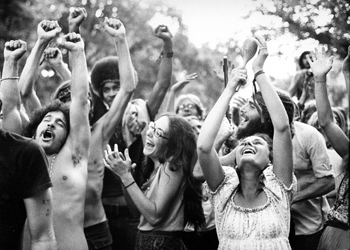
hippies

As the Boomers entered their teens, they began to rebel against the parents who had showered attention and material comforts on them. I believe this rebellion was due to a collective fear of engulfment by overindulgent parents. They were attempting to break away by reacting against the very lifestyle that had given them so much. Of course not every child had overindulgent parents, but teenagers always try to emulate what’s popular or cool. Rebelling against “the Establishment” or the Vietnam War (which also represented the values of their parents) became hip and cool. Adolescent Boomers, having been raised to believe they were unique and special (and most of those middle class and above were able to attend college and were often the first in their family to be able to do so) embraced causes that were anathema to the values of “the old fogies” and at first, really believed their causes were superior to those of their parents. They tuned in, turned on, and dropped out. They experimented with marijuana and LSD. They dressed in hippie clothing and wore their hair long, which horrified “The Establishment.” They listened to rock music, the louder and harder and more offensive to the older generation, the better. They protested the war, attended “love ins” and participated in campus sit-ins, and eventually riots. Young Boomers believed their values were exactly what the world needed, but their attitude was based on entitlement rather than realism. They were idealists who believed the world could be changed by smoking pot and listening to the right sort of music.*

* I’ve amended my attitude toward Boomer idealism some since I wrote this post. Idealism in itself isn’t a bad thing, and some of the youth movements of the ’60s had wonderful intentions–surely there’s nothing wrong with peace and love, and the anti-war, women’s, and civil rights movements (the latter which had actually started in the late 1950s with the Silents) all had their positive points and changed society for the better in many ways. The most disturbing thing about early Boomer idealism was its shallowness–the way it was so quickly abandoned when they entered full adulthood and as a generation they were able to move so quickly from “make love not war” to its polar opposite, “greed is good.”

Due to the sheer size of the Boomer generation, anything they did got a lot of national attention. Besides the many disapproving and negative news stories about the Vietnam protests, communal living, and recreational drug use, others were also beginning to emulate them. The next-older generation (The Silents), who had been largely ignored as they came of age, tried to seem younger by emulating the Boomers in their dress, tastes, and general lifestyle. The Boomers were never short on collective narcissistic supply (both negative and positive), and this continued to feed their attention-getting behavior.

Parents wondered where they had gone wrong, and why the children they had raised so lovingly had turned so rebellious and so insistent on “doing their own thing.” They wondered why this new generation seemed to hate them so much.

By the end of the 1960s, the “hippie lifestyle,” like everything else the Boomers would ever start, had become a lucrative market. But by the time The Establishment caught on, the Boomers were beginning to move on to other things, including embracing what they had rejected.

The power was still in the hands of the older generation of course, so narcissism had not yet become a noticeable part of the culture (although hubris and conformity definitely still was). By the 1970s, the first signs of a growing narcissistic culture would begin to make themselves felt.

1970s.

disco_ball

Boomers, now entering their 20s, had by now largely abandoned their earlier hippie incarnation for a more subdued “back to the land” movement, in which they opted for whole foods, fresh air, and healthy living. Others began to infiltrate the job market, often with degrees in esoteric subjects. Having children was something to be avoided, as Boomers wanted to prolong their adolescence or make a mark on the world. The Pill and newly legal abortion made all this possible. Around the same time, women began to demand equal rights in society and the workplace. The 70s wave of feminism was very anti-child and pro-career. If you preferred to marry and raise children, you were looked upon as a throwback to the 1950s.

Around the same time, various forms of non-traditional, humanist psychotherapies (EST, Esalen, etc.), grassroots religions, and cults became popular. Collectively known as “the human potential movement,” self-improvement and self-development became a priority for Boomers. Putting your own needs before those of others was not only normal, it was considered healthy. New York Magazine dubbed the 1970s “The Me Decade” for this reason. Couples opted to cohabitate rather than marry(because it was easier to break a commitment), and divorce was becoming very common. But the true victims of all this self-discovery were the children.

“Non-parenting” in the 1970s.

Children raised during this time (Generation X and tail-end Boomers) found themselves pretty much ignored, treated as second class citizens, or sometimes even abandoned by their self-involved Silent Generation or Boomer parents, who seemed to put their own needs ahead of theirs. This was a generation full of latchkey kids and kids prematurely taking care of themselves and their siblings while Mom attended to more interesting and “fulfilling” things.

To be fair, it wasn’t all the parents’ fault. The new “me” culture and the women’s movement, which gave women more options that just being mothers and housewives, gave them permission to turn their kids into second class citizens. Second-wave feminism especially (though this movement was probably for the most part a good thing) literally threw out the baby (Gen-X kids) with the bathwater in the 1970s. In spite of then-recent discoveries made by psychologists in the field of early attachment, women–including mothers–were encouraged to put their own needs first. I remember some “child-care” book my mother was reading that I thumbed through that actually advised mothers to not be “slaves” to their children–this attitude extended even to babies! Kids were considered to be small, demanding tyrants who hobbled women’s needs for independence and fulfillment in the outside world, rather than vulnerable little people who happen to have many needs. It wouldn’t surprise me if it were found that disorders caused by emotional neglect and failed early attachment (C-PTSD and personality disorders) are especially high among Generation X and “Joneser” (born 1955-1965)adults. Given the ages of most narc-abuse victims on the web, I suspect this is the case. These were the scapegoated kids of an increasingly dysfunctional society.

Around the middle of the 1970s, a new kind of music (disco) became associated with materialism, hedonism, and over the top sexuality. By now, Boomers had done a 180 from their emergence during the 1960s as hippies, and now embraced the crass materialism they had once rejected. They were ready for a President who would encourage their pursuit of luxury and material success.

At the same time, fundamentalist Christianity, which had been “rediscovered” by some Boomers as an outgrowth of the Jesus movement of the 1960s, was becoming increasingly popular, and the new conservatism was using it as a way to attract newly saved Christian voters.

The new narcissism wasn’t lost on Christopher Lasch, who published his book, “The Culture of Narcissism,” in 1979.

1980s.

yuppies

Ronald Reagan popularized trickle-down (or “supply side” economics), which basically meant allowing people to pay less taxes and keep more of what they earned. This played right into the hands of financially successful, entitled Boomers, who didn’t want to share their newfound wealth. The hippies had become the Yuppies–young urban professionals who had to “dress for success,” live to impress, and have the best of everything. Clothing wasn’t acceptable unless it had a designer’s logo on it. Housewares weren’t acceptable unless they were handmade in Outer Mongolia by native women. Food wasn’t acceptable unless it was “nouvelle cuisine.”

Having the perfect body was a priority, and Boomers started going to the gym or even personal trainers to tone and sculpt their bodies, sometimes to the point of unhealthy obsession. Boomers, mostly in their 30s by now, were finally deciding to have families, but children themselves became a status symbol, and getting your child into the “right” preschool or having the “right” designer clothing, or the “right” dance instructor became all-important. It was common for Boomer parents to watch other people’s children closely, to find out what they needed to do to “one up” each other as parents.

We were all enthralled by TV shows about fabulously wealthy people. Dallas, Dynasty, and its imitators became wildly popular and its stars became icons to imitate and aspire to. With the exception of emsemble shows like Cheers (a show about bartenders) or Taxi (a show about taxi drivers), there were hardly any popular TV shows about the poor or working class or anyone else of humble means. In the 1980s, you would not be able to tune into a new Little House on the Prairie, Sanford and Son, or The Honeymooners, except in reruns.  Teenagers in shows were more likely to be privileged prep-schoolers than inner city toughs like those in Welcome Back, Kotter.   Situation comedies no longer focused on middle or working class people, but on the comfortably upper middle class. Even the cops on police shows were somehow (and unrealistically) fabulously wealthy and always dressed for success.   The rich (or at least aspiring to be rich like the characters in thirtysomething) just seemed more interesting…and worthy of our time.

In 1987, a popular movie called “Wall Street” was released, in which its most famous quip, “greed is good,” became a national meme. While it was intended as a joke at first, “greed is good” quickly became a new philosophy of life, in which greed was not only good but became a virtue. Greed may have been one of the seven deadly sins, but even Christians made an exception for it, and we even had a Christian president who encouraged as much of it as possible. After all, it was the American way and America was a Christian nation, right?

In summary, during the 1980s, narcissism came out of the closet, with the election of a president who encouraged greed, materialism, and entitlements for the wealthy. At the same time, empathy, neighborliness, and general goodwill toward others seemed to become almost quaint, a naive relic of the past. The juggernaut was the new “greed is good” philosophy, normalized by a popular film. Narcissism was no longer something to be hidden; now it was almost something to aspire to.

1990s.

cast_friends

The greed worshipping culture begun in the 1980s continued during the 1990s, as Boomers rose to power and we elected our first Boomer president, Bill Clinton, in 1992. Under Clinton, the economy boomed, and a new breed of Yuppies, the Dot Com entrepreneurs (who were mostly Generation X), rode on the coattails of the newly born Internet, and they made money hand over fist until they went bust several years later. But people still went shopping and the culture at large was becoming increasingly exhibitionistic, obnoxious, and in-your-face (reality shows were born during this time), while corporations grew bigger and more unwieldy (unlimited growth, like a cancer, was encouraged, and smaller companies merged into megacorporations the size of small governments). Meanwhile, government institutions built in the more sedate and community-oriented 1950s and 1960s began to splinter and crumble. The government, especially the part of the government that tried to help its less fortunate citizens and attempted to even the playing field through fair taxation, became The Enemy.

But a backlash was beginning to silently bubble under all the glitz and bling of the ’90s. Back in 1983, a psychiatrist turned born-again Christian named M. Scott Peck published his groundbreaking book, “People of the Lie.” Here, for the first time, was a self help psychology book that focused on “evil”–specifically, people who were evil. The traits described in the book are exactly those of malignant narcissism. The book resonated with many, particularly with Gen-Xers and later born Boomers (Generation Jones), who had been raised by narcissistic parents. In some cases, especially for younger Boomers and early Gen-Xers, these kids had been betrayed by initially doting Silent generation parents who suddenly, during the 1960s or 1970s, seemed to suddenly care only about their own self-development at the expense of their confused and hurt adolescent and preteen children who they no longer seemed to even like much (this is exactly what my experience had been growing up in the 60s and 70s: my parents changed and no longer seemed to care).

But in the early 1980s, Peck’s “evil people” were not automatically equated with narcissists or people with other Cluster B disorders. Until the mid-90s, narcissism–or more specifically, NPD (Narcissistic Personality Disorder)–was simply a psychiatric label given to certain patients with a certain set of traits, who may or may not have been evil. NPD wasn’t demonized yet.

Then along came Sam Vaknin in 1995. Vaknin, a former white collar criminal and self-confessed narcissist, had written a tome about narcissism called “Malignant Self-Love: Narcissism Revisited.” Written initially to obtain supply and a guru-like status for himself, Vaknin’s book actually helped many of the narcissistic abuse victims who read it and recognized their abusers in its 600+ pages. Vaknin’s idea of NPD didn’t fit that described in the DSM: he mixed in with NPD several traits of psychopathy, antisocial personality disorder (ASPD), and Borderline personality disorder (BPD), to describe a particularly dangerous type of malignant narcissist that made the toxic people described in M. Scott Peck’s book seem almost tame in comparison.

The book was successful, and soon Vaknin started his own website, and discussion groups, and abuse victims all over the world jumped on the bandwagon. Vaknin, exactly the sort of person they sought to avoid, had become their savior and guiding light out of darkness.

Until the 2000s, Vaknin’s was pretty much the only voice on the Internet about narcissistic abuse. But in the very late 90s, a few books were beginning to be published about this “new” type of abuse that didn’t necessary include physical violence (but could). Parents, particularly mothers, were the focus, and a subset of the narcissistic abuse community–one that focused on narcissistic mothers and the damage they had done to their now-adult children–formed the template for the explosive ACON (Adult Children of Narcissists) movement.

2000s.

bling

For a brief time, after the tragedy of September 11, 2001, it looked like Americans just might start to care about each other again. There was an outpouring of support for the victims of the 9/11 disasters, and solidarity shown among all Americans. For the first time, regional differences and even racial differences didn’t seem to matter, and Americans were united by their flying of the flag. No one seemed all that concerned by the curtailment of certain freedoms and and increase in xenophobia–after all, it was for the protection of the country, right?

But as a result, the economy was suffering, so George W. Bush Jr. (“Dubya”) gave us all permission to “go shopping.” And so we did. It was back to the bread and circuses and the shallow, materialistic culture of the 1980s through pre-2001.

Reality shows rose in popularity and the badder the behavior, the more popular they got. New celebrities were famous only for “being famous,” having a famous parent, or just for acting badly. People aspired to be just like Snooki and The Situation from The Jersey Shore, or Tiffany “New York” Pollard from Flavor of Love. All of these characters were narcissists, or at least acted that way for the benefit of the camera. And people loved them for it.

During the 2000s, Millennials, the rising young adult generation, born in the 1980s and 1990s, started being being accused of being narcissistic, but if they are, you can blame their parents for having taught them these values. In addition, a lot of gaslighting is going on by older generations, who blame the Millennials for their inability to find jobs that pay a living wage and provide benefits, forcing them to live at home and be dependent for longer than earlier generations–and accuse them of being “lazy,” “spoiled,” and “entitled.” But what about their mostly Boomer and Gen-X parents, who modeled this sort of behavior?

old_boomers

Politicians became more blatantly narcissistic and their lack of empathy sank to new lows. One politician said if you weren’t rich, you should blame yourself. Blaming the victim became increasingly popular, and was even seen by some conservative politicians as a “Christian” way to behave–for if you were favored by God, He would bless you with wealth and material comforts. Religion itself became a way for narcissists to rise to positions of great power, and use their “favored status” in God’s eyes as a way to abuse their flock of followers.

Meanwhile, the narcissistic abuse commmunity continued to grow, and blogs written by abuse survivors were beginning to pop up all over the Internet. The abuse community developed their own lingo, some of it borrowed from earlier movements such as 12-step programs (codependent, enabling, people-pleaser are examples), some from pioneers such as Sam Vaknin (narcissistic supply, confabulation), and some from mental health experts going all the way back to Freud. Some terms were taken from popular movies, such as “flying monkeys” (The Wizard of Oz), and “gaslighting” (Gaslight).

2010s.

tea-party
Tea Party protesters.

Now we’re nearly 7 years into the 2010s. While it’s hard to see any patterns yet, it does seem that the problem of narcissism is finally being noticed by the general public. Pundits and media critics write about the narcissism of politicians and celebrities and “cluster B type” reality TV stars.  Now there’s a call by many for more empathy and community spirit over selfishness, self-aggrandizement, and greed.  2011’s Occupy Wall Street movement enjoyed a flurry of popularity, especially among Millennials (though older generations had their fair share of supporters) before it was ultimately silenced.  But at least it was a start.


Occupy protesters. 

On the other hand, the problem is even worse now, with the possible impending presidency of Donald Trump, who has even been remotely diagnosed with NPD by psychiatrists (breaking their own rule never to diagnose anyone who hasn’t been formally evaluated). Sam Vaknin has called him a Malignant Narcissist (and I do believe he is one) and even publications like Psychology Today and news media have picked up on that and written about it. The news is peppered with so many articles about Trump’s malignant narcissism that it’s a wonder he is still a contender. But Trump has a powerful bloc of supporters (mostly “angry white men”), who seem to be in denial about how dangerous this man could be should he become President. I don’t think he will win. But no other presidential candidate in living memory showed the same level of arrogant, entitled, and grandiose behavior that Trump has shown in his campaign–and politicians are by nature a narcissistic bunch! Can you imagine someone like Trump making it this far 30 or 40 years ago? I can’t. Even ten years ago, someone who acted that way would have been booted from the race during the primaries. We as a nation have normalized the type of pathological behavior someone like Trump displays.

Narcissism is a fashionable topic now. Maybe it’s just a fad, but it’s making people pay attention. I’ve noticed a number of Christians–at least online–who are abandoning the fiscally conservative values held by groups such as the Tea Party, who are about as collectively entitled as you can get (they better get their social security, but to hell with that child who needs special medical treatment but can’t get it because his parents are too poor). It’s probably too soon to tell whether the “social gospel” is making a return, but there does seem to be a greater desire for an increase in empathy, kindness, and community spirit instead of just building up the Almighty Self. The enormous popularity of Bernie Sanders, especially among the Millennials, proves this. Of course a Sanders-type figure wouldn’t have solved all our problems (it took decades for us to get to this point and it won’t be changed overnight), but the fact one made it so far and people actually paid attention gives me a little hope that the tides may be turning. It will be interesting to see what the rest of this decade holds.

*****

For further reading:
1. Are Millennials Really the Most Narcissistic Generation Ever?
2. Why is Narcissism so Hot These Days?
3. Generations Explained

Unnecessariat

This is an incredibly well written and deeply disturbing post that went viral when it was posted and I completely missed until today. The early die-off of poor and formerly middle class whites may be an intentional progression of the social Darwinism that is hobbling this once-great nation.   If it works, you know what will happen next. The “fittest”–the wealthy survivors who thrive under the new and “improved” global economy–will also be the most sociopathic and narcissistic. With the great die-off, will empathy become as extinct as the dodo bird? I wonder.

Anne Amnesia (Blog Author)'s avatarMore Crows than Eagles

I remember AIDS. I’m older than you probably think I am, and I remember what AIDS in America meant in the eighties, when William F. Buckley suggested all “carriers” be tattooed, and the Wizard of Id got in trouble in Canada (fr) for a joke in which Robbing Hood’s “Merry Men” were rounded up into quarantine camps. Mostly what I remember is the darkness- the world seemed apocalyptic. Everyone, at least in the gay men’s community, seemed to be sick, or dying, or taking care of someone else who was sick or dying, or else hurling themselves headlong into increasingly desperate and dramatic activism the like of which has hardly been seen since. I was actually watching the MacNeil/Lehrer news hour when ACT-UP broke in and nearly handcuffed Robert MacNeil to his desk. The tenor is just unreproducible; you get a taste of it in some of Sarah Schulman’s…

View original post 3,661 more words

Have we gone mad?

trump-angel-warrior
Archangel “warrior” Trump.

I wish this were a joke, but it’s not.  There are many “Christian” Americans who actually believe what this article says.   There are people deluded enough to actually believe that a billionaire sociopath, xenophobe, and textbook case of NPD  is the panacea for all the “evil spirits” that threaten this once-great nation and they will be casting their vote in November (the deluded people, not the evil spirits).   Riiiiiight, an orange-skinned, toupeed, former reality television star is God’s chosen warrior against the forces of evil.  .   This is a man who is so narcissistic he even admitted he never asks for God’s forgiveness.  Who has a reputation of being a womanizer and philanderer and who referred to his own daughter as sexy.    Yet many Christians are going to vote for him.

Not so long ago, someone like him would have been laughed out of the primaries.

http://www.charismanews.com/opinion/59276-prophecy-god-sent-donald-trump-to-wage-war-against-destructive-spirits

A similar article singing Trump’s praises for his “truth telling abilities” is illustrated with a painting of Trump as an Archangel (which I have used in this post for its humor value).

Trump is popular because he tells the truth, something Americans are starving for

Divorcing The Donald: Cutting Ties with The Narcissist.

Allison Patton, family lawyer, wrote an eye opening article for The Huffington Post that goes beyond simply describing Donald Trump as an NPD poster boy, which many have already done.

In family law, individuals with NPD are known a HCPs-high-conflict persons. Here, Ms. Patton describes the way Trump’s blatant narcissism has not only alienated him from the Republican Party, but how he could potentially serve as a public example of a serious disorder that family lawyers, judges, and the courts are surprisingly ignorant about–and often unwittingly reward the narcissistic spouse and punish the real victim, due to the narcissist’s glibness and ability to lie convincingly.

Unfortunately, Trump has succeeded in pulling the wool over the eyes of millions of Americans who continue to support him–even though it’s no secret he has been publicly diagnosed with Narcissistic Personality Disorder. Many of these Americans tell themselves, “well aren’t all politicians narcissists anyway?”
Well, most probably have some narcissistic traits, but most are not full-blown NPD like Donald Trump either.

Divorcing The Donald: Cutting Ties With The Narcissist
By Allison Patton, for The Huffington Post
http://www.huffingtonpost.com/alison-patton/divorcing-the-donald_b_9633460.html

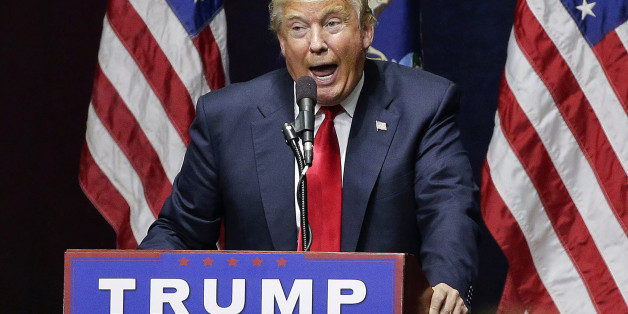
Republican presidential candidate Donald Trump speaks during a campaign rally, Wednesday, April 6, 2016, in Bethpage, N.Y. (AP Photo/Julie Jacobson)

Republican presidential candidate Donald Trump speaks during a campaign rally, Wednesday, April 6, 2016, in Bethpage, N.Y. (AP Photo/Julie Jacobson)

Narcissistic Personality Disorder
A “Cluster B” personality disorder in which a person is excessively preoccupied with personal adequacy, power, prestige and vanity, mentally unable to see the damage they are causing to themselves and often others.

While the Republican Party is desperately trying to cut ties with Donald Trump, the world watches in disbelief. All, that is, but a particular group of women and men with one thing in common: each of them has divorced a narcissist, and some still share child custody with one.

They know the story and could write the script. The successful, gregarious person who swept them off their feet. The promises that followed. Gradually the realization that it was all a façade. There could never be a “we” because narcissists care only about themselves. Then the real nightmare began, the battle to remove this toxic person from their lives. . . . and for those with children, the misery of trying to co-parent with an ex who acts and thinks like The Donald.

As a divorce lawyer, these cases are the most difficult and disturbing. In my family law circle, we refer to someone with a narcissistic personality disorder as “an NPD” (or the more general term “HCP” — which stands for “high conflict person”). The legal battle is always the same: the unaffected spouse tries to explain to the attorneys, judge and appointed psychological expert (if there is one) the narcissist’s behavioral pattern: control, emotional abuse, manipulation, duplicity and the damaging impact on the children. The NPD denies it all and mounts a legal response that consists of blame laying, factual distortions, outright lies and a character assassination of the other spouse.

The experts and the judge are sometimes able to weed through the chaos and confusion, identify the personality disorder at play and make decisions that protect the children and unaffected spouse. Often, however, the legal system gets it wrong. Just as we’ve seen with Donald Trump, the NPD can be very convincing and manipulative. And the court system – like the general public – either gets conned by the NPD or isn’t equipped to manage the level of conflict created by a Donald. Often the court assumes both parties are equally to blame for creating and maintaining a high conflict case, so the innocent parent who is fighting to protect the kids is treated as skeptically as the narcissistic parent.

For decades, there has been little understanding of how to spot and handle personality disorders in family law. As recently as 2011, when I blogged on Huffington Post about high conflict people in divorce court, I received emails from out-of-state divorce professionals indicating the information was new to them and they hadn’t heard the term “high conflict people” used in their family court.

Thanks to Donald Trump and his campaign, the entire world now gets daily lessons on NPD behavior. As disturbed as I am by what the Donald has pulled off, the divorce lawyer in me sees the opportunity here. The Donald is our new high conflict poster child. Those of us who want change in the family law system couldn’t hope for a better example. The common traits and behaviors of this personality disorder are being revealed, in their full horrific glory.

Read the rest of this article here.

Bonus article: Donald Trump’s Amazing Answer to “Do You Cry?”  (Washington Post)
https://www.washingtonpost.com/news/the-fix/wp/2016/01/19/donald-trumps-amazing-answer-on-do-you-cry/
Hilarious.

Millennials and voting.

Michelle Obama Urges Iowa Grassroots Supporters To Get Out The Vote

The Primary election is on Tuesday night, but I’m so out of the loop sometimes that I didn’t even realize early voting ended today.  I always try to vote early because you can avoid all the crowds and craziness.  Sort of like Christmas shopping.

I wasn’t planning on voting today.  I was driving downtown to run some errands.  But I happened to pass by the library and saw all the campaign signs and a long line of people waiting to get inside.  Huh?  Why so many people standing on line when it’s early voting?

I got out of my car and breathed in the warm early spring air.  It was a glorious day, with the sun shining and the birds singing.   A few trees are beginning to blossom.   I walked over and asked someone why the line was so long, and she told me there was only an hour left before the early voting polls closed until Tuesday night!  I’d  made it right in the nick of time.  So I thanked her and took my place at the back of the line. The atmosphere was party -like.  People were excited about their candidates of choice, and the spring weather made things seem festive.

The vast majority of people waiting to vote were young families, many with babies.   I don’t think I’ve ever seen so many babies in one place since I took my own kids to Gymboree classes back when they were tiny toddlers.  A quick mental calculation based on these young parents’ appearance told me they were part of the Millennial generation (born in the 1980s and 1990s)   A few might have been later Gen-X or Gen Y, but not too many.  I’ve been reading about how politically active the Millennials are, something the previous generation (Gen-X) was generally not when they were of like age, oh, about 20 years ago now.   (Has it really been that long?)

millennialvote

There was a 20-something clean-cut young man handing out flyers and another 20-something young woman dressed in hipster garb and covered with campaign buttons enthusiastically talking about the election and handing out flyers for a different candidate. My own 24 year old son has also become politically active in his state.  He’s campaigning for Bernie Sanders (who seems very popular with Millennials, which is ironic since he’s the oldest of all the candidates).  A an aside, Bernie has amassed his enormous popularity among Millennials through social media, especially Twitter, where you can #FeeltheBern becoming an unquenchable fire.    2011’s ill-fated Occupy movement also built its momentum using Twitter to spread the word.   The movement might have fizzled out before it could make a real impact (or been silenced), but I think it was the first real sign of things to come.

Millennials get it.   They’re not taking any more of the same old, same old.  They’re not backing candidates who spout the same old tired rhetoric we’ve become so familiar with, jaded candidates funded by huge corporations who promise change but fail to deliver.  This generation has  inherited a broken nation and no one seems to give a damn.  They have had a terrible time getting a foot in the door of real adulthood because they can’t find decent jobs that pay a living wage and many can’t afford to move out of he home they grew up in.  They are in college debt up to their eyeballs and will no doubt remain in debt until their late middle age or even for the rest of their lives if things don’t change.   They’re sick of being called entitled crybabies, when all they want is the same opportunities that other generations before them did.  They also realize that if things are going to change, it’s going to be them that have to make things change.

bernie_sanders

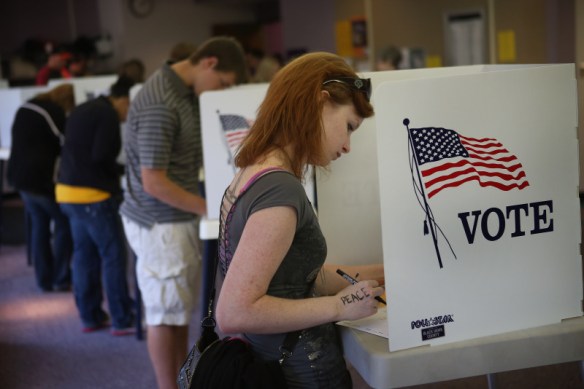
Most of the Millennial generation is now old enough to vote, and they are taking advantage of that right and showing up at the polls to exercise that hard-won right, whether they are male or female; black, white, Hispanic, or “other;” gay or straight; Christian, Jewish, Muslim, or atheist; and regardless of political affiliation (though most seem to be quite liberal or independent).    As Americans, we all have the right to vote, and voting is the only thing that brings real change.   If you fail to vote, do you really have a right to complain?   Although I’m terribly unhappy with the state of this nation and have been for a long time, I always felt guilty griping about it whenever I failed to vote.

So I stood there on  line feeling the spring breeze in my hair and looked around at all these enthusiastic Millennials on line, with their bumper crop of babies and toddlers (the future generation of this country), and felt very proud of this young adult generation, the same one William Strauss and Neil Howe predicted back in the 1990s would become the new “Greatest” generation–the people who would finally be able to save America from itself.