The Vulnerable Dark Triad.

I wrote this article today, but it belongs on both my blogs, so I’m going to be redundant. 😛

“The Narcissist in Chief” (New York Times article)

Republican presidential candidate Donald Trump gestures and declares “You’re fired!” at a rally in Manchester, New Hampshire, June 17, 2015. REUTERS/Dominick Reuter TPX IMAGES OF THE DAY – RTX1GZCO

The Narcissist in Chief
By Scott O. Lilienfield and Ashley L. Watts, for The Opinion Pages, The New York Times, September 4, 2015

WITH the presidential campaign in full swing, a perennial question has resurfaced: How much weight should voters give to candidates’ personalities? The political rise of Donald J. Trump has drawn attention to one personality trait in particular: narcissism. Although narcissism does not lend itself to a precise definition, most psychologists agree that it comprises self-centeredness, boastfulness, feelings of entitlement and a need for admiration.

We have never met Mr. Trump, let alone examined him, so it would be inappropriate of us to offer a formal assessment of his level of narcissism. And in all fairness, today’s constant media attention makes a sizable ego a virtual job requirement for public office. Still, the Trump phenomenon raises the question of what kinds of leaders narcissists make. Fortunately, a recent body of research has suggested some answers.

In a 2013 article in Psychological Science, we and our colleagues approached this question by studying the 42 United States presidents up to and including George W. Bush. (The primary data were collected before Barack Obama’s presidency.) First we took a data set compiled by the psychologists Steven Rubenzer and Thomas Faschingbauer, who for an earlier study asked experts on each president to complete personality surveys on the subjects of their expertise. Then, using standard formulas from the research literature on personality, we produced estimates of each president’s narcissism level. Finally, we correlated these personality ratings with data from surveys of presidential performance obtained from independent panels of historians.

We found that narcissism, specifically “grandiose narcissism” — an amalgam of flamboyance, immodesty and dominance — was associated with greater overall presidential success. (This relation was small to moderate in magnitude.) The two highest scorers on grandiose narcissism were Lyndon B. Johnson and Theodore Roosevelt, the two lowest James Monroe and Millard Fillmore.

Grandiose narcissism was tied to slightly better crisis management, public persuasiveness and agenda-setting. Presidents with high levels of this trait were also more likely to assume office by winning election in a landslide (55 percent or more of the popular vote) and to initiate new legislation.

Read the rest of this article here.

Here is a bonus quiz on political ideology and your best candidates that was suggested by Linda Lee–it can be taken here: http://www.isidewith.com/political-quiz?utm_source=outbrain&utm_medium=cpc&utm_campaign=q_us_hrvd1
I’m 91% Bernie Sanders. 🙂

Yikes! Does this mean I’m a narcissist?

Almost a year ago, I wrote this slightly jocular post after I read an article describing covert narcissism. It was the first time I’d actually read anything about it. Even back then, I recognized the symptoms as fitting me like a glove, but was far away from awareness. This slightly humorous, false self-deprecating attitude was typical of a lot of my posts at the time. I think somewhere deep inside though, I knew.

I can’t believe how different everything seems now.

luckyotter's avatarLucky Otters Haven

yikes
I just finished reading a Scientific American article that delineates narcissists into two categories: Overt Narcissists and Covert Narcissists:

When most people think of narcissism, they think of the public face of narcissism: extraversion, aggression, self-assuredness, grandiosity, vanity, and the need to be admired by others (see “How to Spot a Narcissist“). But as far back as 1938, Harvard psychologist Henry Murray noticed another breed of narcissist among his undergraduates: the covert narcissist. While the “overt” narcissists tended to be aggressive, self-aggrandizing, exploitative, and have extreme delusions of grandeur and a need for attention, “covert” narcissists were more prone to feelings of neglect or belittlement, hypersensitivity, anxiety, and delusions of persecution [I’ve also seen this referred to as “inverted narcissism,” whatever that means].

Um, I’m prone to feelings of neglect or belittlement, am known to be hypersensitive and anxious, and there are times I believe I’m being persecuted…

But it…

View original post 294 more words

Cognitive dissonance and NPD.

narcissism_childhood

I’ve been thinking a lot about the concept of cognitive dissonance and its role in creating a narcissist or turning a narcissist into a malignant one.

Cognitive dissonance is the mental stress or discomfort experienced by an individual who holds two or more contradictory beliefs, ideas, or values at the same time, or is confronted by new information that conflicts with existing beliefs, ideas, or values.

–Wikipedia

A computer will crash or stop working when given conflicting sets of instructions. Although people are not computers (because we have emotions and a soul), if we receive conflicting sets of “instructions” or information about ourselves, it causes so much mental distress that a personality disorder can develop if the conflict appears very early in life.

A child who is constantly invalidated by narcissistic parents tries to correct the cognitive dissonance by “becoming” what the parents tell them they are. If the parents tell them they are evil, bad, always misbehaving, etc. they may become aggressive, overt narcissist themselves to “match” the parents’ assessment of them. If they are told they are incompetent, a loser, stupid, etc. they may develop covert narcissism or BPD instead.

Golden/spoiled children.

Veruca-Salt

Spoiling a child is actually a form of abuse, because being a golden child negates the child’s own reality that they are human and less than perfect. The spoiled, golden child will either try to be as “perfect” as they are told to match their parent’s unrealistic assessment (and a grandiose false self develops from that) or they know they can’t ever be the image of perfection their parents insist they be, and to correct the cognitive dissonance they may become rebellious or adopt covert narcissism (in which the child believes they are worthless and the parents are wrong) as a coping strategy.

Other personality disorders.

Borderline personality disorder (BPD) is also a way to correct cognitive dissonance. I think BPD develops in many children who were both golden children and scapegoats (which is often the case with onlies) who were given inconsistent parenting, sometimes abused, sometimes treated like little gods. That’s why they’re so conflicted and seem to act in contradictory ways that confuse themselves and those around them.

Not all abused children develop narcissism or BPD, but it’s my belief almost all children of narcissists develop personality disorders, all of which are the adult incarnations of childhood attachment disorders.

Malignant Narcissism.

monsters-nietzsche

Malignant narcissism is NPD that is high on the spectrum and mixed with antisocial (ASPD) traits. A low-mid spectrum narcissist (or even a non-narcissist!) can turn malignant during adolescence or even as an adult. I think this is almost always due to some choice they made or action they were forced to engage in that went against their conscience. Let me explain how this works.

M. Scott Peck in his book, “People of the Lie,” (the book that popularized the concept of malignant narcissists as “evil”) told the story of a man who narrowly escaped becoming evil/malignant. The man, a non-narcissist who loved his family dearly, suffered from debilitating panic attacks when crossing a certain bridge on his drive to work. Even though he didn’t believe in the devil, one day while suffering a severe panic attack he made a “deal with the devil”–he told the devil he could take his favorite son’s life in exchange for allowing him to cross the bridge without having any more panic attacks. Of course nothing happened, and the son was fine. The man, filled with remorse over having these thoughts, told Dr. Peck about it, and was told he did the right thing to repent, because otherwise he would have become evil himself, especially had something actually happened to his son. If he had turned to darkness and narcissism, it would have been to correct the cognitive dissonance between what he had done and his internal moral compass. He would have had to discard his previous moral standards and embrace darkness.

A person forced to engage in something they find morally reprehensible, such as a soldier forced to kill innocent civilians, can turn toward darkness. Many veterans return suffering severe PTSD and in some cases seem to have lost the souls they went to war with. Many, who have committed atrocities in war, correct the cognitive dissonance created by doing something that went against their conscience, by discarding their conscience altogether. This isn’t a conscious choice usually, but is the end result of severe PTSD. (I think all personality disorders are, in fact, manifestions of severe PTSD caused by chronic abuse starting when the personality was still forming.)

It’s my opinion that adolescence is when malignant narcissism is most likely to develop, because adolescents are by nature risk-takers and trying to establish a separate identity from their their parents. This usually takes the form of some type of rebellion, and rebellion is normal as long as it doesn’t go too far. Some adolescents may be “dared” by their friends to engage in antisocial activities. Adolescents are so eager to be accepted in a group of their peers that sometimes their desire for acceptance overrides their conscience, which isn’t fully developed yet. If these antisocial activities hurt others (such as robbing someone’s house on a dare), the teenager’s fledgling conscience is halted in its growth, and may be discarded altogether. It’s at this point an adolescent can turn to malignant narcissism. This is why the choices kids make are so important. Here’s an excerpt from my article, “Healing Narcissism: Stephen’s Story,” in which a fictional boy I called Stephen turns to narcissism as a coping strategy, and it all began with a dare.

The Choice.

bullied_child

Stephen recalled a dare when he was 8 years old. A group of boys who had bullied him dared him to set a paper bag of dried dog poop on another boy’s rickety wooden front porch and set it on fire. The boys promised him that if he did this, they would no longer bully him and they would be his friend and protect him against any further bullying. Stephen knew that doing this could set the other boy’s house on fire and at first he protested, explaining what could happen. At this point he still had a conscience. But the boys threatened him and told him if he didn’t do it, their bullying would become worse and they would kill his pet rabbit. Stephen believed them, so against his will, he complied.

They set out after dark for the targeted house. The boys watched from the darkened yard as Stephen lit the paper bag on fire and hesitantly walked up the front stairs of the boy’s porch and set it next to a dead potted plant. The deed done, all the boys ran away before anyone saw them. Stephen looked back in time to see the flames ignite the plant, and quickly start to spread over the railings of the rickety old wooden porch. He felt awful and considered going to the police, but he didn’t dare. He went to bed that night and had terrible nightmares.

The targeted boy’s house burned down and he, his baby sister, and his mother had to be taken to the hospital to be treated for smoke inhalation. Soon after, the family moved away, never to be seen again. No charges were pressed because no one knew who the culprit was.

To protect himself from his unbearable feelings of guilt and shame, Stephen shut off his painful emotions of guilt and conscience. From then on, the group of bullies accepted him as one of them, and they continued to engage in tormenting other children and even petty crimes.

This is an example of cognitive dissonance. Stephen would not have been able to live with himself had he not turned to narcissism as a coping strategy. The irony here is that, the more intense the child’s guilt or shame over committing an act that goes against their morals (or the more heinous the act), the more likely it is they will turn malignant, because to do otherwise would mean the overwhelming shame they feel could likely cause them to become severely depressed or even suicidal. This isn’t an excuse for anyone to turn to narcissism (or malignant narcissism) as a coping strategy, but is an unfortunate reality.

Acquired narcissism.

narcrealityshows

Sometimes people who become extremely successful, such as celebrities, sports stars, business leaders or politicians, can become narcissists, even if they were not narcissistic before their success. It doesn’t happen to all of them, but if it does, this is another example of how cognitive dissonance tries to “correct” things. In order to close the mental gap between their actual assessment of themselves as imperfect humans and the adulation they receive from the outer world that treats them as if they’re somehow more than human, a successful person can turn to narcissism to align their self-assessment with the way they are regarded by others. This is why some celebrities become so full of themselves or manipulative. It’s a form of acquired narcissism, but because it’s acquired fairly late in life and isn’t due to a choice, this type of narcissism may be temporary and only last as long as the person remains famous or very successful. If they fade into obscurity, the person faces a narcissistic crisis, but after that I think they can return to a non-narcissistic way of being in the world.
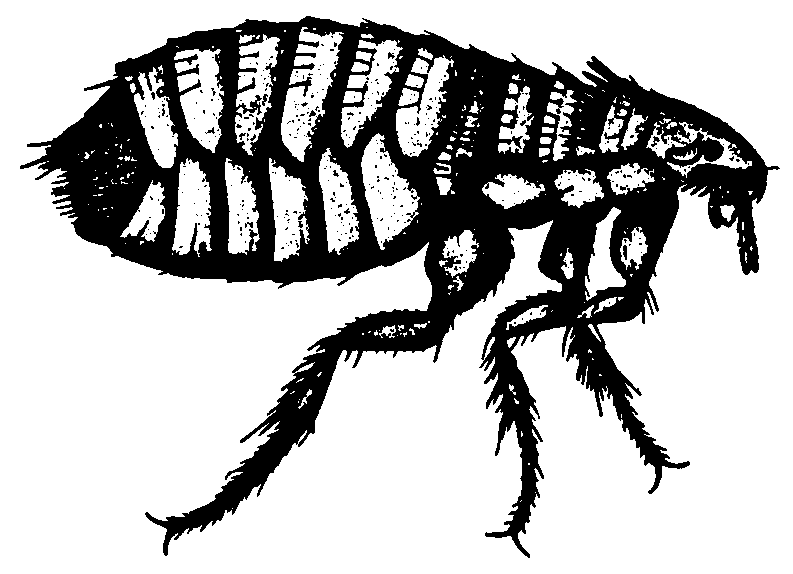
When the “fleas” of narcissism go too far.

flea

Narcissists infect people, just like a disease. They have the uncanny ability of turning people into one of them, if you’re around them long enough. That’s why, whenever it’s possible, No Contact is always the best course of action. You cannot change a narcissist or reform them. What will happen instead is you will start to take on narcissistic behaviors yourself.

Narcissists are body-snatchers and will snatch yours and before you know it, you can become one of them. It may be the only personality disorder that’s contagious. Hanging around one too long is very dangerous to your self esteem, your identity, and even your soul. It’s more dangerous than making your escape, even if you don’t have a dollar to your name.

If you were raised by them, you may have a serious problem. Many (though not all) children of narcissists become narcissists or borderlines themselves. Because narcissistic parents can’t form proper bonds with their children and either use them as supply or scapegoats, children of narcissists more likely than not develop severe attachment disorders in childhood, and attachment disorders can easily become NPD, either covert or overt, somatic or cerebral. If the child is a little luckier, she or he can develop BPD, PTSD and many other disorders that make adult life difficult.

flea_cartoon

Overt/classic/grandiose narcissism (the type that best fits the criteria in the current DSM) develops most often in golden children who were held on a pedestal and could do no wrong, or were terribly spoiled, or it can develop in child who served as the parent’s flying monkey. It can also develop in a scapegoat who wants to prove their narcissistic parents wrong. Overt narcissists are usually extroverts who are good at playing the role of a confident, aggressive leader and many of them become financially and professionally successful. They are good at maintaining their mask for as long as they need to.

Covert/vulnerable narcissism usually develops in a scapegoated child who cloaks their grandiosity in an outer cloak of deference and humility, usually as a way to avoid punishment for acting too arrogant or aggressive while growing up. It can also develop in a child who is sometimes a scapegoat and sometimes a golden child. In a way, they are worse off than an overt narcissist, because they have a double layer of masks (false selves): the grandiose mask that hides the undeveloped, atrophied true self within, and a meek, shy and deferent outer mask that cloaks their grandiosity and sense of entitlement. That’s why a covert narcissist can be easily pushed around or bullied by others, but underneath their seemingly nice, quiet image there is seething envy and anger that isn’t expressed unless they are pushed to the limit and explode in rage. Their rage and envy is also likely to come out in passive-aggressive ways. Yet a covert narcissist is easier to cure because (a) they are far more likely to want help; and (b) their lives are miserable and their brand of narcissism isn’t adaptive in today’s world.

BPD is more common in women and some female covert narcissists may actually be diagnosed with BPD, because the disorders can seem so much alike and women aren’t diagnosed with NPD as often as men are. BPD probably develops most often when there is ambiguous attachment to the mother during early childhood and the child is inconsistently rewarded and punished. They learn early that people and life are unpredictable and no one can be trusted. They fear abandonment because they were never able to tell if their parent would love them or push them away. BPD also is correlated with early sexual abuse.

Fleas of narcissism are deadly because with prolonged exposure, they can cause permanent infestation. If it’s at all possible, cut off any narcissist in your life or avoid them as much as possible. Watch for red flags so you can escape before it’s too late because escaping once they “have” you is far more difficult and can be dangerous.

If you were raised by narcissists, no matter how damaged you are, if you didn’t become a narcissist yourself, consider yourself extremely lucky. There is hope for you to eventually be able to live a normal, happy life. If you’re a non-malignant narcissist, there may still be hope but the road to becoming a normal and happy person is going to be longer and harder.

How to recognize a covert narcissist.

covert_narcissism

When most of us think of narcissists, we think of the overt type– arrogant and full of themselves, outwardly aggressive, flying into rages if they don’t get their way or their supply is not cooperating, confrontational, demanding, and high-maintenance. Think of the tyrannical boss everyone’s terrified of; the demanding, high maintenance, conceited friend; the roommate who feels entitled to “borrow” your clothes, car or money without asking; or the abusive and philandering husband–those are examples of overt narcissists. They’re in your face. They’re outwardly obnoxious. They may seem nice when you meet them (otherwise they wouldn’t be able to trap you as prey), but as soon as you’re in their clutches, they begin to show their true colors.

The second type, covert narcissists, seem much more benign, even after they’ve reeled you in as a source of supply. They don’t necessarily drop the nice act. That’s why they’re so dangerous. Because it’s hard to put your finger on what these dolls are actually doing, you may think there’s something wrong with you for feeling wary or nervous around such a “nice” person. They are the true wolves in sheeps clothing. The red flags are much harder to see in a covert narcissist. But make no mistake–they are predators too.

Some examples of covert narcissists include:

— the compassionate and friendly nurse who “accidentally” kills her patients.
— the needy friend who gives you unasked for gifts or does unasked for favors, then complains that you are acting selfishly if you want to spend time doing something besides being with them.
— the spouse who plays “martyr” and puts everyone on a guilt trip because of “everything they’ve done for you.”
— the friend who seems to have a neverending litany of problems, but when you try to help them they never take your advice or give you a long list of reasons why the advice you give them will never work. This friend is an emotional parasite, and will make you feel drained.
— the parasitic spouse who won’t get a job (and doesn’t appear to be trying). They keep giving you “reasonable” excuses as to why they can’t find one or why they haven’t tried to look. Really, they are just trying to live off you.

grovel
Illustration by Mike Reed.

The red flags we normally look for to peg a narc are much more difficult to detect in a covert narcissist, because they can seem so friendly, charming, generous and even altruistic (yes, altruism can be selfish when it comes with strings attached). The website Info Self Development, in their article about covert vs overt narcissists, lists these tell tale signs for recognizing a covert narcissist:

–Emptiness, seems to have something missing that you can’t quite put your finger on
–Stubborn, rarely apologising unless they want something from you (see narcissistic supply)
–Ability to make you feel guilty, even when something is not your fault
–Entirely self centered; they are the center of their own universe
–Expert liars; charming, hypnotic, a master of manipulation
–Projecting their insecurities and defects onto you
–Very sensitive to constructive criticism
–Inability to form intimate relationships
–Inability to feel genuine remorse
–Blaming others for their problems
–Low emotional intelligence
–Highly materialistic
–Extreme lack of empathy
–Superficially charming
–A victim mentality.

I think the last one is important– victim mentality. These are the do-gooders, the “altruists,” the first person to volunteer for the church fundraising drive, the mother who volunteers as the classroom mother, the favor-doing friend. If you fail to “appreciate” their good deeds to their satisfaction or live up to their unrealistically high expectations (for example not volunteering ALL your free time to the church fundraising drive), watch out. That’s when they will work behind the scenes to ruin your reputation through gossip, lies, and triangulation. They are “martyrs” and you are selfish and evil for not sacrificing yourself the way they have “for you.”

talk_to_me

They can also appear in the form of a needy “friend” who monopolizes your time with a seemingly neverending litany of problems or crises (sometimes brought on by themselves). They never seem to learn from their mistakes, and they will eat up your time and patience pleading or begging you to “fix” things for them. They almost seem to take a perverse pride in being victims. But any advice you give them will be dismissed or ignored. They will make excuses as to why the advice you gave them wouldn’t work. In some cases you may even be blamed for giving them the “wrong” advice, thereby making their problems even worse. They are emotional vampires who take and take, but never give anything back in return. If you ever have a problem, fuggaddaboutit. They won’t be there for you.

Covert narcissists may seem nice, but they aren’t. As with any narcissist, the best way to handle them is by avoiding them or cutting off contact with them if you can.

Yikes! Does this mean I’m a narcissist?

yikes
I just finished reading a Scientific American article that delineates narcissists into two categories: Overt Narcissists and Covert Narcissists:

When most people think of narcissism, they think of the public face of narcissism: extraversion, aggression, self-assuredness, grandiosity, vanity, and the need to be admired by others (see “How to Spot a Narcissist“). But as far back as 1938, Harvard psychologist Henry Murray noticed another breed of narcissist among his undergraduates: the covert narcissist. While the “overt” narcissists tended to be aggressive, self-aggrandizing, exploitative, and have extreme delusions of grandeur and a need for attention, “covert” narcissists were more prone to feelings of neglect or belittlement, hypersensitivity, anxiety, and delusions of persecution [I’ve also seen this referred to as “inverted narcissism,” whatever that means].

Um, I’m prone to feelings of neglect or belittlement, am known to be hypersensitive and anxious, and there are times I believe I’m being persecuted…

But it gets even worse…

In the 90s, psychologist Paul Wink analyzed a variety of narcissism scales and confirmed that there are indeed two distinct faces of narcissism, which they labeled “Grandiosity-Exhibitonism” and “Vulnerability-Sensitivity”. He found that both shades of narcissism shared a common core of conceit, arrogance, and the tendency to give in to one’s own needs and disregard others. But that’s where the similarities ended.

Okaaaaayyy, I admit I can be selfish, but I don’t think I’m arrogant or conceited. But read on…

While Grandiosity-Exhibitionism was associated with extraversion, aggressiveness, self-assuredness, and the need to be admired by others, Vulnerability-Sensitivity was associated with introversion, hypersensitivity, defensiveness, anxiety, and vulnerability. Further research by Jonathan Cheek and Jennifer Odessa Grimes at Wellesley College found a moderate correlation between covert narcissism and the Highly Sensitive Person Scale developed by Elaine Aron.

pugdog

Uh…I’ve frequently mentioned being an HSP and I’m definitely introverted….

In other words, while introversion, sensitivity, and narcissism are all partially separate traits, hypersensitive covert narcissists are more likely to report that they are introverted and sensitive.

hiding

I’m so busted. I’m almost afraid to take the test at the end.

But if I am narcissistic, I think I’m a pretty benign narcissist, as the disorder runs on a continuum from somewhat narcissistic to murderous evil psychopath. I would guess the same is true of all HSPs (who I noticed tend to blog about narcissism a lot)–that we aren’t malignantly narcissistic. I think a lot of HSPs and people who tend toward introversion also tend to feel guilty about everything too and feel bad when we hurt others, so that doesn’t seem to indicate malignant narcissism or psychopathy anyway. I think they missed the mark here, because narcissists don’t feel guilt or care if they hurt others.