I saw someone’s tweet today that caught my attention because I could relate to its sentiment.
True story @ work tonite I completely crushed a paper cup out of stress at work & almost threw it away but felt bad for the cup so I used it.
And a few minutes later:
This falls under the same category as me feeling sad after accidentally stepping on an ant, but worse.
I thought I was the only one who ever had these absurd feelings of remorse or pity for inanimate objects, but apparently I’m not.
I remember a couple of years ago, when I was painting my kitchen Kelly green, I accidentally flung some of the paint from my brush all over a small throw pillow that had somehow wound up on the kitchen floor and I’d neglected to pick up and bring to safety. (Don’t ask me how it wound up on the kitchen floor). A small fake-velvet tan pillow with floral embroidery was permanently ruined with Kelly green paint and it was all my fault. I had to throw it away and I felt like weeping.
How absurd is that? I was never attached to that pillow; it was worth nothing. I probably found it for a buck at some yard sale, but I remember feeling like the worst person in the world because the thing looked so pathetic with lurid green paint splattered over its delicate tan velvet adorned with Chinese-factory made embroidery.
I remember when my daughter was four, she tossed a Pound Puppy out of our car window to see what would happen to it. Of course I had to keep going, but in my rearview mirror, I saw the car behind me run over the stuffed toy and flatten it like a pancake. Its petroleum-based stuffing exploded all over the road like popcorn. My daughter laughed. I felt inexplicably sad.
There have been other times like that too. Like the time that, in frustration, I threw a paperback book (one I’d never read and never intended to read) against the wall and split its binding. Or the other time I accidentally burned a cheap oven mitt that had a cute lattice-like pattern on it. I actually liked that oven mitt, but it had cost me $3 at Dollar General. There were a gazillion more just like it. Besides, it was intended to be stuck inside a hot oven. Getting burned was one of the risks that came with its intended use.
None of these were valuable objects, or even objects that had any special meaning to me. They were just part of the background — things I’d acquired and that were just there. Things I never thought much about. Of course I realized they had no feelings, and could feel neither emotional or physical pain. I’m not an idiot.
And yet, when bad things happened to them — or worse, when I did bad things to them — I felt just terrible, as if I’d killed someone. Would these inexplicable feelings of guilt had been less had I loved those objects or had they been valuable, either financially or in the sentimental sense? Maybe I’d have grieved over their loss but have been spared that guilt. After all, those poor objects were never loved, and then were destroyed through my own carelessness. Maybe if I’d cared, I wouldn’t have done things like spill green paint all over them or thrown them hard against a wall in frustration.
Sometimes I also feel bad for abandoned or neglected objects. There’s a website I visit sometimes called Terrible Real Estate Agent Photos. The site owner has a bizarre obsession with those ubiquitous plastic outdoor chairs. He or she calls them the “garden chairs of solitude” and positions them in poignant configurations that just rip your heart out, like in this photo:
Whenever I rescue some forgotten or abandoned object from certain destruction by the trash compactor that barrels down the road every Monday, I feel like I’ve done a good thing for it, as if the thing actually cares.
Yes, we are living in very dark times. Not just here in America, but in many other countries around the world. It’s enough to send the most emotionally healthy person into the pits of despair, but we can’t allow that to happen. Succumbing to despair and hopelessness is exactly what the enemy wants, because when we’re helpless and hopeless we can lose our souls. We become weak and malleable spiritually, and more easily used by the forces of darkness.
Martin Luther King, Jr. was a man of God, a preacher who fought for social justice and what was right and good in the eyes of God — a stark contrast to many American “Christians” of today, who somehow believe wealth, whiteness, material success, and greed are godly, and if you aren’t blessed with these things (and if you don’t vote Republican), you aren’t one of the “chosen.”
This uniquely American belief system is based on Calvinism, which is in my opinion an ugly and hateful philosophy that teaches that Jesus didn’t die to save everyone, but only the “elect.” The belief that only certain individuals can be saved and this was determined before you were born is called “predestination.” Many fundamentalist Christian churches believe in this. To those who hold this doctrine, there is nothing you can do if God hasn’t chosen you. You will not only be cursed with disease, misery, and poverty, but will ultimately wind up being punished for all eternity — just because God didn’t favor you. This horrible and cruel doctrine is in direct opposition to what Jesus taught us. Today, of course, someone who acts the way Jesus did would be called a “socialist.”
If God is really like that, I want nothing to do with him. That God is worse than the devil himself. But I don’t believe God is like that.
We live in dark times, and more and more people are embracing a false Christianity that is anything but. They may read their Bibles and attend church every Sunday, but it means nothing. Even the enemy can spout Bible verses. Those of us who practice kindness and compassion, and care about the less fortunate, the immigrants, the old, the sick, the children, and the oppressed and suffering people of this world (the way Jesus did) have a duty to pray for those who have been deceived. We must not lose sight of the truth, whether it’s refusing to listen to “fake news” or “alternative facts,” or not denying such realities as climate change or the fact that none of us can survive without each other. We are not islands and were never built for individualism above community. We are tribal creatures, intended to support each other and work toward the greater good, not just what is good for us. What benefits you benefits me, and benefits the entire society.
We must pray the ignorant ones see the truth and stop listening to and believing the lies that run rampant across the land these days. America is not the promised land and it never was. People who believe that America is God’s chosen nation and only the white and rich are blessed by God aren’t evil but they are ignorant.
America may fall just like the Roman empire, but those of us who believe God loves us all and who reach out to others rather than kicking them when they’re already down will be able to transcend all the hatred, violence, greed, and selfishness that defines America (and the world) today and find peace and joy in our relationship with God.
Someone on Facebook by the name of Joel Tooley lives in Melbourne, Florida, where the Trump rally that took place on Feb. 18 (really, a campaign rally for 2020!) was held. Mr. Tooley is not a Trump supporter, but he wanted his daughter to see a real, live president — and he was curious about what it would be like himself. So he went. He got more than he bargained for.
Here is his experience, which he wrote about. The post is long, but what he describes here made the hairs stand up on the back of my neck. I always avoid using religious language in these sort of posts, because it just seems too dramatic — but there does seem to be something truly demonic about this president, his administration, and some of his most rabid supporters; he seems more like a cult leader than a newly elected president. Most of his most ardent supporters are fundamentalist or charismatic Christians — but from everything I have seen from this president, he is anything but Christian and his values, actions, and behavior oppose anything resembling real Christianity or anything that Christ taught. He has deceived so many millions of people with his lies.
Trump Visits Melbourne, Florida.
By Joel Tooley
What I am about to write and what you are about to read may make some people very uncomfortable, if not angry.
That is not my intention nor is it okay with me to cause anyone to stumble. That being said, what I experienced tonight was so dramatic that I cannot help but reflect on it and share what I experienced.
A few days ago, people across the United States heard the news that our newly elected President would be visiting Melbourne, Florida – our hometown. It is no surprise to many that I do not support many of the objectives and “campaignisms” of Donald Trump. I know many people who voted for him – friends, family, church people who all voted for their own reasons. The point of this experience is not to relay all of the reasons why I think he should not be the president. Those points are moot – he IS our President.
Now, I am enough of a sentimentalist that when I found out THEEEE President was coming to town, I got online quickly and reserved two tickets.
The tickets were being given away by the Trump-Pence campaign; I found it odd that the tickets indicated that this was not a government/White House event & that this was a campaign event. I have, of course, posted a joking post about that earlier. What I discovered was that by hosting this as a campaign event, Mr. Trump could determine who was and was not allowed in the venue. If he came on an official visit, they could not prohibit anyone from entering and he couldn’t sell his campaign merchandise.
So, in essence, he was only allowing his supporters in the room. Well, with a few exceptions…
I talked my 11-year-old daughter into coming with me. After all, how many times do you get to see the President of the United States in person – let alone in your hometown? I was eager for her to have this experience. It has to be a pretty cool thing, as a kid to see Air Force One, the President and the First Lady.
The event started at 5 PM; we got in line at the venue shortly after 2 PM and the line was already pretty long. There are several mini stories to be told about that experience but don’t need to be told for this post. Suffice it to say, it is always an intriguing sociological experience to be surrounded by people in line for something for which they are fanatics – whether it is for a movie premier, a live concert, the release of the latest beanie baby or Cabbage Patch kid. Fanatic people are fascinating to me.
While I am not a fan of Trump, I certainly did not want to come across as a vigilante protester while standing amongst some of his most adoring fans. I truly wanted to see if what I was going to witness in person was any different than what I had observed on TV.
The entry into the event was very impressive. I have always admired the professional posturing of the Secret Service, including those from our own local law-enforcement who were on duty serving in this capacity. These are women and men who should be highly commended for placing their lives on the line.
We entered the venue at 3 PM, two hours before the event started. As we entered, everyone was being handed pom-poms and Trump campaign signs. The hosts made sure everyone had a sign in their hand. Someone shoved one into my hand and gave pom-poms to my daughter.
I felt like a sheep in wolves clothing.
Music was playing loudly throughout the venue as it filled up with hundreds of people. I would guess there were eventually at least 3000 people in the room. It was nowhere near full, but there certainly were a lot of people there. From my view, the crowd was 99.9% white folk. I did see a row of about 10-12 supporters who were black, wearing T-shirts that said, “Trump and Republicans are not racist” – they were positioned in the seating area directly behind the podium.
We were about three rows of people from the very front and had a very good position to view the President and the platform. As people were coming in, there was a lot of excitement and a strong sense of patriotism. Approximately every 15 minutes, the music would be a little more enthusiastic and party-like. I posted my play-by-play feedback of “God bless the USA!” in an earlier post…it was almost church-like. People sang along, raising their hands and were emotionally moved by this anthem. It was intriguing to watch. People were being ushered into a deeply religious experience…and it made me completely uncomfortable.
I love my country; I honor those who sacrificed their lives for our freedom and I respect our history and what we stand for, but what I experienced in that moment sent shivers down my spine. I felt like people were here to worship an ideology along with the man who was leading it. Don’t get me wrong, it wasn’t the song per se – it was this inexplicable movement that was happening in the room. It was a religious zeal.
“People were being ushered into a deeply religious experience…and it made me completely uncomfortable.”
You might liken it to the experience fans would have after their favorite team won the Super Bowl – faces painted, banners flying, confetti in the air and celebrating.
But this – this was deeper.
A couple of local politicians got up to bring greetings followed by state representative, followed by one of our Congress representatives. A soloist sang, “God bless America” and there was a strong sense of patriotism in the room. A pastor got up to pray and repeatedly prayed throughout his prayer, “Thank you for making this the greatest nation on earth…in Jesus’ name.”
Uh-uh. No. No way, josé.
Pastor, this is not the greatest nation on earth. The greatest nation on earth does not exist. Are we a great nation? Definitely. But there are many other great nations as well. Pastor, you have your eyes on a different kind of “greatness” and certainly a different kind of kingdom. Shame on you for praying those words in Jesus’ name!
Suddenly, the music changed from the pep rally theme to something that seemed more Star Wars themed. The crowd went crazy and turned towards the opening of the airplane hangar that was the venue, just as Air Force One pulled up.
What a magnificent sight! That enormous airliner is absolutely breathtaking. The crowd was going wild; signs waving in the air, people cheering, and every cell phone was positioned to take photos and video. As the First Lady and the President emerged at the top of the stairs, the air was electric! It really is a magnificent image to see in person!
As they entered the venue and walked to the platform, there was terrific celebration. I have been in the room when other Presidents were in a similar mode – it is always such a meaningful experience to be that close to them, regardless of whether or not you view them with adoration. Theeeee President of the USA!
The First Lady approached the platform and in her rich accent, began to recite the Lord’s prayer.
I can’t explain it, but I felt sick. This wasn’t a prayer beseeching the presence of Almighty God, it felt theatrical and manipulative.
People across the room were reciting it as if it were a pep squad cheer. At the close of the prayer, the room erupted in cheering. It was so uncomfortable. I observed that Mr. Trump did not recite the prayer until the very last line, “be the glory forever and ever, amen!” As he raised his hands in the air, evoking a cheer from the crowd, “USA! USA! USA!”
Just as the President begin to speak, a short grandmotherly lady in front of us asked me if I would help hold her walker – the kind that has a seat built into it. She said, “I need to climb up on it and hold something up.” Such an odd request at such an odd place at such an odd time. So, I helped her.
She held a pillowcase that had something written on the front of it, words I could not see. She climbed up onto the seat, wobbly-legged and held the sign up above her head. People in front of her turned around and started jeering and yelling at her. After holding her sign up for about 10 seconds, she climbed back down and thanked me. I asked her what her sign said – it read, “You had your chance, now resign!”
The very first words out of the President’s mouth were the words of a bully. That is not simply one person’s perspective, it is factual. He immediately began badgering and criticizing the media; like a bully inciting a crowd.
Now, do I think the media needs to be held to a high standard and be able to be held accountable? Absolutely! The media as a whole has become sadly non-journalistic and more entertainment, in my opinion.
Call it what you will, but I was completely dumbfounded as the most powerful leader in the world began his speech by badgering the media. The crowd began screaming angrily at the entire press corps that was present.
“Literally, everything that he began speaking about evoked this angry response from the crowd. Immediately following the words of prayer that Jesus taught his followers…”
He could have said something inspiring and worthy of a Tweet or Facebook post, instead he emerged as an overly powerful bully. Literally, everything that he began speaking about evoked this angry response from the crowd. Immediately following the words of prayer that Jesus taught his followers…
It was then that I heard two ladies off to my left chanting, not yelling or screaming but chanting, “T-R….U-M-P; that’s how you spell – bigotry!” They repeated the rhyme over and over.
Two ladies in front of them began seething and screaming in their face while shaking their Trump signs at them. Another couple standing behind them started screaming at them as well. One of the chanting ladies had her eight-year-old daughter on her back; the other had a severely disabled child in a wheelchair in front of her. As they continued chanting, the people around them became violently enraged. One angry man grabbed the lady’s arm – that’s when I went into action. I barged through the crowd and yelled at them to back off. My heart wasn’t racing; I just instinctively became a protector.
I didn’t actually want a Trump sign, but one of the volunteers had shoved it into my hands as I walked through the door earlier; “Make America Great Again!” That sign probably saved someone from getting hurt. I held the sign close to my chest as I positioned myself between the chanting protesters and the angry mob. My 11-year-old daughter was clinging to my arm, sobbing in fear.
The two angry, screaming ladies looked at me, both of them raised their middle finger at me in my face and repeatedly yelled, “F*#% YOU!” Repeatedly.
I calmly responded, “No thank you, I’m happily married.” Their faces and their voices were filled with demonic anger.
I have been in places and experiences before where demonic activity was palpable. The power of the Holy Spirit of God was protecting me in those moments and was once again protecting me and my daughter in this moment.
I raised my voice and calmly said, “These ladies have the right to do what they are doing and they are harming no one; this is America and they a right to express themselves in this way. They are harming no one.” A couple of other people around me stepped in and supported me in protecting them as a barrier, as well.
My daughter was shaking in fear as she clung to me. The one man behind the protesters shoved himself forward, grabbed the lady by the arm and screamed with multiple expletives, “I’m going to take you out! This is my president and nobody has the right to disrespect him and nobody has the right to keep me from hearing him!”
I wish I could have captured the expressions of that man on camera. I will never forget him.
The little girl on her mother’s back was crying, completely frightened. I leaned forward and reassured her in her ear, “Your mommy is being brave and we will not let these people hurt you. You are afraid because these are angry, awful people. We will not let them hurt you or your mommy. You are being so brave and your mommy is doing something very brave.”
That’s when another lady screamed in my face that what I was doing was un-American. I just chuckled and responded, “What I am doing is completely American – I’m standing up for people who are being bullied – it doesn’t matter if I agree with them or not. You came here to see the President, now ignore these ladies, turn around and enjoy the show.” Without explanation, they calm down and turned around to hear what Trump had to say.
The two protesters then moved towards the back and left the building. I got a couple of high-fives and “thanks for stepping up for them” from bystanders . I wanted to say, “Thanks. Where were you when the the demons were screaming and fists were getting ready to start swinging?”
Once again, the environment reminded me of some church experiences I’ve had. Bystanders.
I have no clue what Trump was saying at that point – draining the swamp, vetting refugees, and other things. Oh yeah, I heard people chanting, “Build that wall, build that wall!”
I realized then that we were not listening to someone presidential, we were listening to someone terribly powerful.
My kid was shaken – she had just seen some of the worst of humanity. We edged ourselves away from the front of the room to the opening of the hangar so we could get a clearer picture of Air Force One. I wanted to give her at least one positive presidential memory.
The crowd was much thinner at the back of the room, people were leaving by the hundreds. Outside, there were two jumbotrons set up for a potential overflow – there really wasn’t a need for them. There were maybe a couple of hundred people outside watching on the big screens.
Not too far behind that group was a large group of protesters.
Inside, Trump had rallied the group by giving a little bit of attention to the “paid protesters outside.” Now, I can’t speak for all of them, but I asked a few where they were from and why they were there – every single one of them were from different cities in Florida and could quickly articulate why they were there. They were not paid protesters – not the ones I spoke with.
I’m trying to separate how I actually feel about this man and his campaignisms. I know why people voted for him; I know why people voted against his opponent. But, at the end of the day, what I felt from his leadership in this experience was actually horrifying. There was palpable fear in the room. There was thick anger and vengeance. He was counting on it. I don’t think I’m exaggerating when I say that it would not have taken very much for him to have called this group of people into some kind of riotous reaction.
“…what I felt from his leadership in this experience was actually horrifying. There was palpable fear in the room. There was thick anger and vengeance.”
Now, not everyone in the room was a part of the angry mob mentality – I looked around the room and saw many people who could quite easily be folks from my neighborhood, folks from my church, folks who were planning to go grab a bite to eat at Cracker Barrel afterwards. Folks who truly wanted to see America “great.” The people who support the Republican Party want to see some needed changes in the government – the people that were there for that reason, are by and large good folks. But those are not the people the President was inciting – they are not the people he was leading. He was rallying the angry, vigilant ones.
As we began to leave, I knew my daughter could not possibly care less about Air Force One or the fact that she saw the President of the United States and his wife, in the flesh. I truly had hoped that she could have had that sentimental experience.
What she WILL remember is the angry, violent man screaming demonic vitriol at a child and her mother. She will remember the two ladies screaming at her Dad, her pastor – flipping the middle finger and using the F word repeatedly.
Now, I know there are people who are convinced that I am jaded and cannot fairly give this man a fair chance. Perhaps that’s true. But please remember, especially those of you who know me well, I am a student of culture and human behavior. I am not a stubborn, close minded individual who likes to stick to the status quo. I know there are people who long for me to see the good things about this President and to talk about THOSE things. I know there are people who want me to realize that not everything he is doing is bad and that every President has their strengths and weaknesses and…
I know there are people who, when they see these words and hear my thoughts will feel badly because perhaps they can’t like me as much as they once did because they don’t agree with me. They want me to like the President that they like – they want me to see him the way they see him.
I’m sorry. I cannot. You see, the angry, F-word-spewing man is what has been depended on throughout this campaign and is the one who is still being counted on to sustain the message. I tried.
As we left the room, these words were echoing in my mind, “Our Father, who art in heaven, Hallowed be Thy name. Thy Kingdom come, Thy will be done…”
At the end of the day, I’m a citizen of a nation – I have a leader who God is very aware and who has tremendous responsibilities. I MUST and will pray for him. I’m a citizen of this world and I must continue to see beyond my own limited world view to seek ways to obediently serve Christ. But greater still, I am a citizen of a different kind of Kingdom – the Kingdom that strives for peace, mercy, kindness and a love-relationship with the King of kings.
It drives me crazy when I get one of those orange slips from the Post Office saying I got a package or certified letter but am not there to sign for it. Being the worrywart and catastrophizer I am, I always imagine the worst. Is the IRS auditing me? Did someone die? Is it an eviction notice? What kind of bad news is it anyway? I mean, it HAS to be bad news. Right? What else could it be?
Well, to be fair, I’ve also received certified letters for JUNK MAIL. Those just get thrown out when I finally go to the trouble of driving to the post office and turn in my slip. And then I get really mad. Why are they wasting my time (and theirs)? Why would anyone send junk mail that way anyway? So, it could be that. It could be junk mail. Please God, let it be junk mail. I’d rather be annoyed than get bad news.
I was actually sleeping when the notice came. I think I remember hearing a vague knock on the door, but I wasn’t awake enough to register it in my head as something real at the door.
Of COURSE, when I woke up, it was 10 minutes past twelve, ten minutes too late for me to go to the post office to fetch whatever catastrophic news I was about to receive. And of COURSE, the Sender was left blank. Grrrrr. So I went online to the USPS website and typed in the long number on the back of the slip. I HAD TO KNOW.
Well. It turned out the sender is from the city where my dad lived and his wife still lives. You may recall my dad passed away June 6th of last year. I still have no idea what I received, but I’m thinking it might be some of the old pictures of me and other things I’d requested from his wife months ago. Maybe it’s even that pastel portrait of me at age six! I’ve wanted that for a long time but I was sure it was thrown out with the trash. It still may have been. I still have no idea what I’m getting, but at least now I know where it’s coming from so it most likely has something to do with my dad.
I really hope I’m getting some of those old pictures or my portrait. Fingers crossed!
Like his hippie predecessors, Steve Bannon wants to take down the Establishment — only this time from the far right. (credit: Huffington Post)
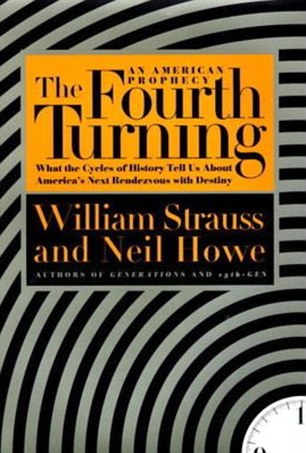
One day back in 1997, while I was a stay at home mom and my kids were both in school, I felt bored, so I decided to visit the library and find something interesting to read. The book that caught my eye and I decided to check out was called The Fourth Turning: What the Cycles of History Tell Us About America’s Next Rendezvous with Destiny, written by two political sociologists named William Strauss and Neil Howe. Little did I know how this book would change my entire view of history and in many ways, change my life. The predictions Strauss and Howe made 20 years ago were spot on — almost all of them have become reality. I can honestly say I’m a believer and have been for a long time. Their theory seems to make a lot of sense and the predictions made in their book are uncannily accurate.
Many people dismiss The Fourth Turning as bunk or even hocus-pocus. Some people regard it as not much better than superstition — on par with the worst conspiracy theories, astrology, reading tea leaves, or Nostradamus prophecies. But Strauss and Howe’s theory that history runs in cycles that keep repeating themselves are based on sound research and their own and others’ observations of history over hundreds of years, since well before the founding of America. In their view, history is not linear — it seems to repeat itself in varying forms approximately every 80 -100 years, with each cycle containing four distinct turnings — lasting about 20-25 years each– and in which four distinctly different generational archetypes (themselves created by child rearing methods in fashion during the turnings each generation was born in) both foment and affect each of the turnings –and how the generations themselves are affected by the turnings.
Before I get to the main point of this article — which is about Trump’s right hand man Steve Bannon and the ways he is misusing and even abusing Strauss and Howe’s theory of history –let me spend some time describing how the theory works for those who may never heard of it. A few months ago, I wrote an earlier article that focused more on Millennials’ role during the crisis we’re now facing (we are in a 4th turning right now and reaching its climax). From that article, I’m going to copy and paste the part that gives an overview of how the theory works so I don’t have to write that part again from scratch.
Generational and Turning Theory: a four-part repeating cycle of history.
Turnings throughout American History.
We are currently in the Millennial Cycle, the fourth cycle since the Revolutionary War. We have been in this cycle since V-Day at the end of WW2, in 1946 — more than 70 years ago. We are reaching the end of the Millennial cycle, and about to begin a new one, once the fourth turning we are in is resolved. But things are going to get a lot worse before they begin to improve. It’s not necessarily going to be Armageddon; it’s just what happens in 4th turnings.
The last 4th turning (which was actually the final turning of the “Great Society” historical cycle) started suddenly in 1929, with the financial crash on Wall Street that plunged us into the Great Depression. In 1942, America entered WW2. We came out victorious in that war with newfound prosperity and confidence and we were now a world power to be reckoned with. Full of optimism and confidence, we entered the first turning of the Millennial cycle — the booming (but conformist) postwar years of the 1950s and early 60s. Lots of victory babies (Baby Boomers) were born, who were very much indulged, and the first turning of this current cycle saw shining new suburbs, brand new scientific discoveries, and a brand new, modern infrastructure where kids and families felt safe.
Approximately 8o years before the Great Depression/WW2 was the Civil War, and 80 or so years before that was the American Revolution. It goes even farther back than this, but I won’t go into detail about those cycles here, since we weren’t fully “American” yet.
One example from earlier times was the Renaissance, actually a first turning that occurred after The Black Plague (a 4th turning) that set civilization back into motion for a variety of reasons. Prior to the Plague were a thousand years of dark ages (more commonly known as medieval times, which lasted from the 400’s to the early 1500’s). Dark ages are eras when time seems to stand still and turnings do not occur. Generations don’t follow the archetypes we’re familiar with — they don’t change much over time because there are no historical turnings. One generation pretty much follows the same life pattern as their parents, grandparents, and ancestors, and most progress comes to a screeching halt. People live very difficult and short lives, eeking out an existence as best they can. The middle ages were the result of a disastrous 4th turning — the Fall of Rome. It could happen that if this turning ends badly, we could be thrust into a new dark age, but it’s not likely. The Protestant Reformation was the Awakening (second turning) of the same cycle the Renaissance (or the Plague) began. There were other cycles after this that led up to the Revolutionary War and the founding of America, but I’m not as familiar with those.
We are about halfway or more than halfway through the current crisis (which as yet, has no official name). It started (depending on who you ask) with either 9/11 in 2001 or the housing crisis of 2008 (most followers of the theory believe 2008 was the real start date of the current 4th turning — which means we’re only about halfway through).
4 Generational Archetypes.
A Boomer at different life stages criticizes (from left to right) “square” GI/Silent parents; “hypocritical” fellow Boomer Yuppies; “materialistic” Gen Xers; and finally looks to her Millennial kids as future saviors. (credit: Millennials Rising, 2000).
The four generational archetypes are Prophets, Nomads, Artists, and Heroes. The most recent Prophet generation are the Boomers, born during the prosperous postwar years (their predecessors were the Missionaries born during the Gilded Age). Prophets are born in a First Turning (a time of prosperity and conformity) and tend to become narcissistic and moralistic as they age.
The current Nomads are the Gen-Xers (who correspond with the Lost Generation), who are born during a Second Turning (the most recent was the Consciousness Revolution, which took place in the ’60s and ’70s). They grow up feeling neglected and unworthy and as a result become apathetic to world issues and lack trust in their leaders. As children with self involved Silent and Boomer parents they were often left to fend for themselves from a young age. They have collective low self esteem. Think back to the Lost Generation, the last Nomad archetype before them. Those were the orphaned kids, young toughs, Chicago mobsters, and the poor newsboys who roamed the streets during the late 1800s and early 1900s.
Artists are the Silent Generation (the oldest generation still alive but are dying off fast), They are always born during a Crisis, or a Fourth Turning (the new Artists are still being born now). The current Crisis began either in 2001 with 9/11, or 2008 with the housing crisis (the jury is still out on the start date). They are overprotected as children (today’s helicopter parenting) and strictly disciplined. They grow up to be peacemakers and believers in checks and balances. We have never had a Silent president, but they have provided reason, empathy, and logic, and worked behind the scenes to keep us from going to dangerous extremes — until now.
Heroes are born during a Third Turning (the most recent one being the Culture Wars of the ’80s and ’90s), when individualism is high but institutions built during the First Turning are beginning to unravel. The last generation of Heroes were the GI Generation, also fondly known as The Greatest Generation, who are remembered as our WWII heroes and the builders of the prosperous America of the midcentury. Almost all of them have died off by now. They have been replaced by the Millennials.
This may sound like hocus-pocus, but it’s not. The overall character of each of the four generational archetypes is influenced by the turnings in which they were raised and came of age in, and the parenting styles of that particular turning. In turn, the generational character combined with the life stages they happen to be occupying at a given time (what S&H calls “generational constellations”) both foments and influences each of the four turnings themselves.
Thus,
Prophets, born in a time of prosperity, conformity, and increasingly indulgent parenting, become self confident but by adolescence, they begin to rebel against the stultifying conformity, and set off an Awakening (Second Turning). During young adulthood, they are experimental idealists. As they rise to power during midlife, they have become vocal, highly opinionated, and passionate about whatever values they have adopted, leading us into a Third Turning (culture wars mentality). They tend to be judgmental and engage in black and white thinking, convinced that only their way is the right one. Prophets’ parents are usually Heroes or Artists.
Nomads, born in a time of questioning traditional values and changing social mores, are often neglected by their self involved parents who seem more interested in their own personal growth instead of them. In reaction, they become self sufficient early on (latchkey kids), but become cynical and reach adulthood with collective low self-esteem. They tend to distrust the system, which they regard as having failed them and of all generations, they are both the most conservative and least likely to be politically involved. They care more about pragmatism and “just getting things done” than about values and ideals. Their parents are usually Artists or Prophets.
Heroes, born in a time of institutional failure but increasing choices and the beginning of the cultural polarization of a nation, are increasingly protected by their stressed-out parents (who perceive the world as more dangerous), and are encouraged to achieve great things but also tend to be micro-managed and overly controlled. As they rise into adulthood, they realize the things promised them are not going to materialize, and take matters into their own hands to change the system to one that will work for them. Their parents tend to be Prophets or Nomads.
Artists, born during a national Crisis, are overprotected (“helicopter parenting”) and strictly disciplined. They are the children most likely to be told to be quiet, stay out of the way and not bother the adults, who are trying to deal with a dangerous world. Artists tend to be obedient conformists until midlife, when they finally begin to rebel, often spurred on by the Prophets born right after them. But caught between two more powerful archetypes (Prophets and Heroes), they tend to never take one side or the other, and learn to be sensitive peacemakers instead, concerned with checks and balances, and “reasonable”and “fair” policies that don’t make waves. They attempt to bring people together. Their parents are Nomads and Heroes.
It’s interesting to note that no Artist has become President during the Millennial Cycle (the 80-year historical period we are currently still in), but Bernie Sanders, a textbook example of the Artist archetype, came awfully close.
It’s also interesting that a Crisis forms just as peacemaking Artists are at their lowest point of influence–when they are in early childhood and very old age. In other turnings, their peacemaking and diplomatic character keeps us from heading into a real crisis, so nothing really gets out of control, no matter how bad a situation potentially is. It all gets handled somehow, and America remains intact. Not so in a fourth turning, when Artist diplomacy is almost completely missing and things become chaotic and there seem to be barely any checks and balances left to keep warring factions from doing real and permanent damage.
I’ve posted this video before, but it’s a very easy to understand overview of how generational and turning theory works. There’s nothing woowoo about it. It’s based on sound historical observations that repeat over time.
The 4 Turnings.
The four turnings are approximately 20 – 25 year time periods encompassing a particular national mood, which is shaped by the generational attitudes and the age brackets they happen to be in at the time. Whatever generation happens to be in their prime adult years (midlife) and in the most important leadership roles, tends to set the overall tone for the turning in question.
Thus,
A First Turning, with Heroes in midlife (and Artists as their helpmates), is concerned with institutional building, scientific advancement, prosperity for all, family life, and indulgent parenting. Children are highly valued and given pretty much whatever they want. Remember, their parents just came out of the worst time in history and never want their children to have to experience what they had to. There is a narrowing of the gap between the richest and the poorest. Individualism is not encouraged; it’s a time of conformity. Sex roles seem to be at their least ambiguous. A first turning tends to be unconcerned with matters of a religious or spiritual nature, idealistic values, or social change. Building bigger and better institutions, a government that works for (instead of against) the people, and scientific discovery seem to be priorities. The last First Turning we experienced were the prosperous post-war years (“Pax Americana”), until Kennedy’s assassination in 1963. We are due to enter a new First Turning within 5-15 years, or whenever (and if) the current Crisis is resolved. The Gilded Age, with its indulged Missionary children, was the earlier analogue to Pax Americana. The romantic myths we still have of Christmases of “olden times,” with Santa Claus and sleigh rides for well bundled rosy cheeked children and their loving families arose during that earlier first turning. The Nutcracker story is a great example of what life was like for the indulged Missionary children of the Gilded Age.
A Second Turning, with peacemaking Artists in midlife (and idealistic Prophets in rising adulthood and adolescence), is a time of great social upheaval and a greater focus on matters of a religious, spiritual, or social nature. Less value is placed on institution building, bureaucracy, and scientific advancement in favor of things of a more esoteric nature, such as discovering altered state of consciousness (through drugs, meditation or other means), civil or womens’ rights, and rebelling against the “establishment.” There is a great deal of experimentation with different lifestyle choices, but children born during this time tend to be dismissed as burdensome to self-development. The most recent Second Turning was the Consciousness Revolution, which started with the first campus protests and the civil rights movement, and ended with either Reagan’s election in 1980 or his “Morning in America” speech when he was re-elected in 1984. The earlier analogue to the most recent Consciousness Revolution was the Romantic movement back in the 1880s and 1890s. Women’s suffrage, communal “back to nature” living (think of Walden), campus protests(!), and lots of religious groups (including modern Christian charismatic groups and fundamentalism as well as “the social gospel”) sprang up during this time.
A Third Turning, with impassioned and judgmental Prophets in midlife (but with Artist checks and balances still in place and disaffected Nomads just trying to get by), is in some ways a continuation of a Second Turning, except that the pendulum begins to swing back to greater social conservatism and more law and order. The left and right tends to become polarized, with both sides thinking only they are right and setting off ugly culture wars. Institutions, which still thrived in the Second Turning (though they may have stopped being built) begin to atrophy and unravel. Distrust abounds, especially toward government, which seems to take a backseat to shallow entertainment and “bread and circuses.” Escapism into shallow entertainment continues into the Fourth Turning (the reality shows that have been popular since the ’90s are the modern equivalent of the circus freak shows, vaudeville acts, and dance marathons of the 1920s and 1930s.) Sex roles are at their most ambiguous during this time, and the gap between the wealthy and less wealthy widens. The most recent Third Turning started with Reagan’s presidency in the early 1980s and ended sometime in the first decade of the new millennium (the most likely dates are 2001 or 2008). The last Third Turning before the most recent one is characterized by the excesses and opulence of the 1920s, the worship of money and material wealth, the jazz age (considered rebellious music at the time and the Lost incarnation of rap and hip hop, a musical form that was later incorporated into the Big Band music of the GI Generation, much as hip hop has been incorporated into Millennial EDM and dance pop), and the brazen “bad behavior,” political apathy, and disrespect shown by Lost young adults toward their Missionary elders.
AFourth Turning, with now-pragmatic, non-nonsense Nomads in midlife (and Prophets in high level leadership roles as early elders) is a national crisis, with no Artists to keep things in check. No matter what the Crisis itself is, things tend to go awry and quickly go out of control. Children are overprotected in this newly dangerous world, and adults just try to get by as best they can, but have little trust in their government or the people who run it. But it’s also during the Crisis that the seeds are sown for the new cycle that will begin in the First Turning: renewed community spirit and people in crisis helping each other. This could be seen during the Great Depression and WWII. What worries me is that so little of that is seen during this Crisis so far. But maybe it’s still too early.
On crises that don’t end well.
If a Crisis ends very badly, it could spell the end of or the fracturing of that particular society, or even–in a very bad case scenario–the end of modernity or even civilization as we know it. If a Crisis ends well, it will lead to a First Turning and a brand new historical cycle (we are currently in the Millennial Cycle, and have been since 1946). If the Millennials are thwarted in their efforts to rebuild society to one that will work for them (and for everyone), we could fall into a Dark Age or a banana-republic-like dystopia with an accompanying loss of progress, or even of modernity. In the very worst case scenario (should humanity survive), we could even revert to barbarism and the complete loss of technological and scientific progress.
Who is Steve Bannon and what does he know?
Steven Bannon is Trump’s chief strategizer and adviser. He seems to have so much influence over Trump’s decisions that people have jokingly (or not so jokingly) referred to him as President Bannon. I’m sure this doesn’t sit well with Trump, but I’m not going to discuss Trump’s narcissism; we already know all about that.
Steve Bannon is a filmmaker, businessman and far-right (now known as alt-right) activist who has no political experience. However, he is intelligent and has read Strauss and Howe’s books and considers The Fourth Turning his bible. He is also a white supremacist and heads up the alt-right, neo-Nazi news website, Breitbart News. Breitbart News is populated by neo-Nazis and people affiliated with the KKK. For all I know, Bannon might himself be a member of the KKK; I know many of the Trump administration’s supporters are.
Following the 2008 financial crisis, Bannon made a film called Generation Zero. Given the fact it’s really subtle propaganda for the far right, it’s actually a well made film, and is palatable enough (no racist slurs) that I could see how it might have been used to win gullible or ignorant people over to his side. While the film addresses the excesses and abuses of Wall Street in the film (so you almost think he might sympathize with the Occupy protesters even though it’s really more Tea Party), he also seems to blame the entire financial crisis on the narcissism and excesses of the hippies of the 1960s, who morphed into these greedy Wall Street bankers. Like all propaganda, there are grains of truth here, but they are intended to disguise a far right agenda that is far from benign (which I will get to later). I recommend watching the film, especially because of its detailed discussion about the four turnings and Strauss and Howe generational theory (which is a valid theory in my opinion), but please be mindful of the hidden alt-right message here.
Bannon is not only a white supremacist and outspoken member of the alt-right, he is also a great admirer of Vladimir Lenin, a Russian Communist dictator from the early 20th century. It’s jarring how this administration seems to regard certain dictatorial Russian leaders (such as Putin) as mentors at best, and possibly even as heroes. But I digress. In one of his most damning statements to the press, Bannon said,
“I’m a Leninist. Lenin wanted to destroy the state, and that’s my goal too. I want to bring everything crashing down, and destroy all of today’s establishment.” — Steve Bannon for The Daily Beast, 2013.
There is also a video of him being interviewed on Fox and Friends in 2014, in which he says something along these same lines, but I’m not able to find the video now. Perhaps it’s been removed. In that interview (which I did see so I’ll paraphrase), Bannon said that the only way to enact change was to create mass rioting and chaos.
How Bannon is using historical turning theory for his own dystopian agenda.
Bannon appears to be using fourth turning theory for purposes of destroying our democracy and, knowing we are at such a vulnerable point in history and bloodshed is more likely than not (there is always bloodshed in any fourth turning), he seems dead set on using what he knows to instigate mass unrest, suffering, strife and upheaval by enacting outrageous policies that enrage the left and any people of reason (the way I see it, the Left are now the real conservatives, who don’t want to lose what little democracy and freedom we have left). He seems to want America to become a permanent hellish dystopia run by authoritarian rulers who allow no freedoms to the people and no mercy shown to anyone who isn’t white and Christian.
An article appeared on The Huffington Post the other day, which I will link here. It goes into more detail about Bannon and the Trump administration’s real intentions and it’s disturbing reading.
This article deeply disturbed me for a number of reasons. Bannon seems to be cherry-picking S&H’s theory, using it for his own evil ends, and in the process totally discrediting a perfectly good theory of history that until now, was almost unknown. William Strauss died several years ago, and I’m sure would be turning in his grave if he knew the ways his theory is being used and may soon be associated with the alt-right and extreme racism, even though it was never intended to be used that way. Bannon completely leaves out the fact that, in any fourth turning, there is also (toward the end) an increase in a sense of community, with people helping each other, and this renewed sense of community helps sow the seeds for the first turning to come (if the crisis ends well). Fourth turnings are always bad, but they don’t have to be completely devastating, and they do have their good points such as strengthening community spirit and fomenting a desire for families to stay together and protect each other. I also think it’s incredibly immoral of Bannon to “stir the pot” and actually attempt to instigate chaos and bloodshed that is bound to happen on its own anyway.
My comment under this post:
To be fair, there is validity in 4th turning theory. I read S&H’s book in 1997 (also their excellent “Generations’); these 80-100 year cycles are pretty obvious, and S&H nailed the timing of the 4T — many years ahead of time. So it all seems pretty valid. You have to read the book with an open mind and not through Bannon’s dark filter. That being said, I completely disagree with Bannon’s racist, authoritarian politics and I also do not believe this is a war of Judeo-Christianity against Islam. It’s a war alright, but it’s a civil war between those on the far right (like Bannon), who want to see a new authoritarian, xenophobic regime with all our freedoms removed, and those who (like me) want to see a more European style social democracy that puts the people first. There’s no telling how things will resolve and what sort of first turning will result in a few more years (or ten more years, if you go by the 2008 start date). Bannon’s vision of a new America is hell to me, and I think, to most. I do agree it may not end well, and at the very least, many will die and our physical borders may be altered. I also think that Bannon mis-using 4T theory to his own ends to create global chaos is evil beyond belief.”
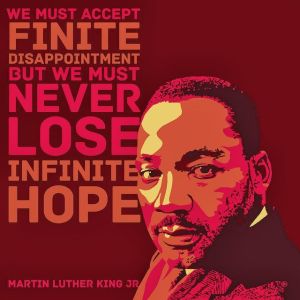
I’m not giving up hope for a better future.
Credit: Norman Rockwell (member of the Lost generation) — “The Golden Rule” (1961)
In spite of the country feeling like it’s cracking up like a bar of Turkish taffy, I’m not giving up hope. Perhaps this unfortunate presidency is actually the wake up call we all need for change to actually happen. Already, there are new movements getting under way that show no signs of stopping. The new and growing Indivisible movement seems to be the Left’s answer to the Tea Party, and seems better organized with clearer goals than Occupy was. Demonstrations are taking place in every major city and are spreading to the suburbs. There’s a huge one going on in Raleigh here this very weekend (I wish I was there!). I think people are finally waking up to what is happening. To quote the movie Network, they’re mad as hell and not going to take it anymore! The sheep have become tigers.
Here is another comment I wrote on a Facebook group about 4T theory. It describes what I would like to see happen in the future and how this crisis might be resolved, if things go well:
If the 4T began in 2001, it has only a few years left. We have reached the peak of the crisis, and it’s a wake up call to a lot of people. It will get worse, but is not unresolvable. We will have 4 years of hell under this president (or whoever replaces him, such as Pence) and quite possibly, California and other states (perhaps the entire west coast) will secede. All this will happen very quickly. For a short time it will be absolute hell. I don’t have to describe that — I think we can all see what sort of hell it will be. In 2020, Sanders runs again (he says he will) and this time, Millennials who sat out this election (and are all of voting age by then) go to the polls in droves — and Bernie wins (I simply cannot see Trump winning over Bernie after all the damage he will do and is already doing). Also, more of the Boomer generation will have passed on and will have less influence than they do now. Millennials, now reaching midlife, rail behind Sanders (or whoever rises to power to replace him, since he is quite elderly even now) and begin to enter the political sphere and have some influence. The New Silents [the kids being born now who are entering their preteen years or early teens] will be their helpmates, as S&H predicted. They begins to rebuild society with the help of those of us older generations who want the same). This brings us into the 1T. But instead of celebrating victory, this time, the first few years will be about recovering from trauma and helping each other recover. It will be about reconstruction more than victory, so perhaps Millennials won’t become as hubristic as GIs were. The infrastructure will be repaired and rebuilt, and for the first time, we will have socialized healthcare, in addition to some modern version of those things we are about to lose (Medicare, social security, good public schools, etc.). If the 4T began in 2008 and not 2001, it’s going to take longer. Things could get much worse and we could be destroyed completely. So I hope we’re nearing the end of it. I also don’t see us being as much of a world power as we were the last time around, we will have learned humility. That’s actually a good thing. We need to put an end to our lack of humility, narcissism and greed, once and for all, and relearn empathy and community spirit, even if it means our borders are smaller and we have less power in the world.
Neil Howe Interview: Inside Bannon’s Brain
After writing this post, I just came across this video. It’s an interview with Neil Howe, one of The Fourth Turning‘s authors, setting the record straight about his theory. (Sorry, I am not able to embed this video).
Psychology, when it’s offered at the high school level, is offered as an elective course — which means it’s not required to graduate. Many, if not most, high schools, don’t even offer Psychology as an option. It’s only offered at the larger high schools, and not usually until Junior or Senior year, after required courses in math, English, languages and history are fulfilled. Abnormal psychology, which goes into more depth about mental disorders and includes personality disorders, isn’t usually offered until the college level, and only to those students who have chosen a psychology or sociology major.
I don’t understand this. Knowledge about psychology is necessary for us to understand our own behaviors and those of our fellow humans. It can help kids be able to detect red flags or signs of mental illness in others, including in our leaders. In my way of thinking, psychology is a life skill and is so much more useful in our daily lives than things like algebra or trigonometry, which are rarely thought of again once a student graduates and only have practical use in the scientific or technical fields. Do any of us in our 40s, 50s, or 60s actually remember how to do a proof in Geometry? Do any of us actually remember some of the dates we had to memorize in History or can reproduce the Table of the Elements without having to refer to outside sources? Not that such knowledge doesn’t have value — it makes you seem smart or at least educated. But really, how are these things relevant to living a successful adult life unless you work in these fields or teach them yourself?
If Psychology were offered at the high school, or even at the middle school level, I think kids would be making better choices in their friendships, relationships, and even in their voting practices as they grow older. They would know better what they are dealing with among the people they wind up going to school with, working with, and having to deal with day to day.
I think anti-bullying education should also be a part of a psychology program, especially for young middle school students, where bullying is at its most vicious and where kids are more vulnerable to the trauma caused by bullying than they are at the high school or college level when their sense of self is more developed. Practical lessons in mindfulness or anger management could be adapted into a middle- or high-school curriculum as well. I think all kids — not just kids with impulse or emotional problems — would benefit from such classes. It would help them develop their emotional — not just their cognitive — intelligence.
We are now saddled with a president who is a diagnosed malignant narcissist (remotely diagnosed by actual psychiatrists, but it’s common knowledge now) and whose rash and impulsive actions are showing that he’s a greater threat than anyone could have imagined. His cabinet picks aren’t much better. I think if psychology (including abnormal psychology) had been a required course for kids, starting at the middle school level, as they reached voting age, they would reach adulthood with more emotional intelligence, and take into account the personality traits of the candidates and choose those who seemed more in touch with reality and more mentally sound, regardless of their political beliefs.
It was an “unsinkable ship,” crowed its hubristic builders. But the Titanic wasn’t unsinkable, and there were far too few lifeboats to save everyone it carried, so many of its passengers perished in the ice cold waters of the northern Atlantic during the early morning hours of April 15, 1912.
The sinking of the Titanic was a horrible disaster, but was a small one compared to the impending disaster we are seeing unfold before us in America right now.
The “unsinkable ship” is sinking.
We in the U.S. have become complacent, believing our leaders who told us that terrorism could never happen in America and we would always be a free nation, safe from dictatorial leaders. And, at least since the end of WW2, this has been the case.
But now we are seeing where our complacency has taken us. The checks and balances we used to take for granted that would not allow a sociopath like Donald Trump to rise to power have been systematically gutted and now we are facing the unthinkable.
Why did we assume it could never happen to us? Just because nothing like this has happened in its 241 year history, doesn’t mean it can’t now. This country isn’t even half the age that the Roman Empire was when it fell.
We think we are special but we’re not. We’re not the first nation something like this has happened to. It’s happened in Russia, Germany, China, Eastern Europe, and many other nations. The danger is that we are so big and powerful in comparison to, say, 1942 Germany, or even the Soviet Union before communism fell, that what has happened can and probably will have worldwide consequences. The fallout may reach far beyond its borders.
We are not special and this isn’t the first time in history, or even in recent history, that something like this has happened. We never learn from history though, not from its big lessons, like WW2 Germany, or its small ones, like the sinking of the Titanic.
I spend pockets of time here and there throughout the days just wracking my brain trying to figure out what went so wrong. I replay our conversations in my head and try to decipher what this meant or why she said that. I try to figure out what the fuck I did wrong.
It’s devastating and crazymaking. Unfortunately, being suddenly rejected by a mental health professional seems to be pretty common. People who have never been in therapy sometimes have trouble understanding how devastating this can be. We become extremely attached to our therapists through a process known as transference, especially when the therapy is of the psychodynamic type (as opposed to behavioral/cognitive methods like CBT). The therapist acts as a surrogate parent and for a therapist…
It’s the 4th week of Advent, the preliminary weeks leading to Christmas that are recognized by the Catholic Church (and also, I believe, all liturgical or “high churches” like the Episcopalian, Lutheran, and Orthodox churches). In the Catholic faith, Advent extends beyond Christmas itself, to the Epiphany (Little Christmas), which is celebrated on January 7th.
I have missed the previous two Sundays, and felt like sleeping in today, too, but made myself go, because I always get so much out of the Mass, especially the Eucharist, which the Mass leads up to. Sometimes laziness wins though, and I always regret it later. I wasn’t going to let that happen again today!
As a pretty liberal Christian (even for a Catholic), I don’t think non-church attendance is necessarily a sin. I don’t think church attendance is necessary for salvation; only having faith is. Many people are able to live a Christ-like life and stay close to God and retain their faith in spite of not belonging to any church. They are self-disciplined: they pray every day, read their Bible, read devotions, and ask God for forgiveness when necessary. I’m not one of them. I need to have a church to go to, otherwise I get lazy and “forget” to stay close to God. I start slipping back into the “world” with all its shallowness and banality and fail to act the way Jesus did. I slip back into sinful and toxic thinking and start nursing doubt.
So today I went to Mass, and as always happens, I left feeling uplifted and peaceful in my heart. The Eucharist (communion) is powerful medicine for me. I admit I have doubts about some of the Catholic doctrine, and issues with some of its rules. However, my church seems to emphasize God’s love over the hell-fire and brimstone scare tactics used by so many other churches to get their adherents to comply, including some of the more conservative Catholic churches. My church isn’t constantly preaching about abortion, homosexuality, or sin. Every homily (analogous to the sermon for Protestants) is preceded by readings from the Bible, and the homily itself based on Biblical verses about God’s love and how much Jesus loved us, so much that he died for ALL people (not just a selected few, as Calvinists believe) so all of us can achieve salvation.
The highlight of the Mass is the Eucharist, which is really a re-enactment of the Last Supper. I do believe, as a Catholic, that the host (communion wafer) and wine actually becomes the body and blood of Jesus Christ once it’s ingested. I believe this because of what it does to me inside. Once I ingest, I always feel a warm liquid feeling of peace and loving feelings in my heart, and this overcomes any worries or negative feelings I may be experiencing. That tiny sip of wine certainly isn’t enough to alter my mind, so I know it’s much more than a physical effect; it’s a spiritual one. It’s the Holy Spirit inside me working on my heart and soul. During the Eucharist, and for a few minutes following it, the choir sings softly about opening your heart to the Lord and his Divine Love. I spend the next few minutes kneeling, thanking Jesus for this gift of Himself, and praying for it to do good things within my soul. It always does.
I also notice that during the week, I feel more loving toward humanity, get less irritated and worry less, and good things seem to happen. I also seem to have a clearer direction of where I’m going spiritually.
The feeling I get from partaking in communion isn’t unlike taking a Klonopin! But it’s so much longer lasting and I feel like it actually changes and opens my heart, which a Klonopin (which only reduces anxiety) can never do.
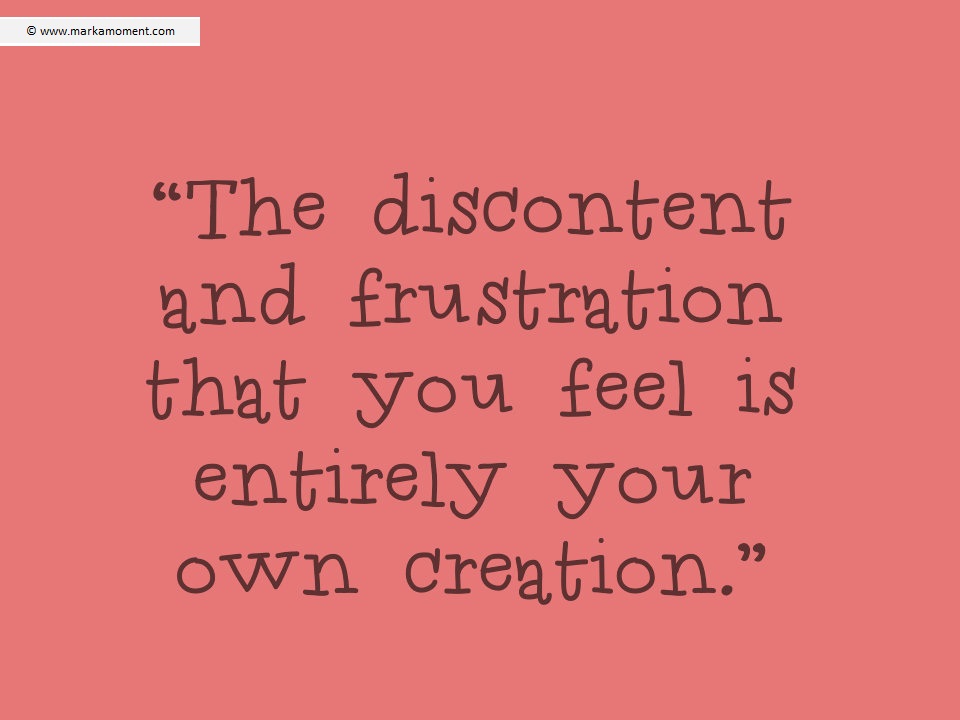
Meme with a victim-blaming (gaslighting) sentiment typical of the “war on unhappiness” movement.
Following is a PDF file of an excellent (and long) article from the September 2010 issue of Harper’s Magazine tracing the rise of the positive thinking movement, and how it’s been taken to ridiculous and heartbreaking extremes, leading to the victim-blaming mentality and society-wide narcissism so pervasive today. This attitude that we can all be our own gods and have everything we want if we’re just “happy enough” even infiltrates its way into churches, where “Christian” preachers like Joel Osteen are basically telling their flocks that if they only plaster on a winning smile and just be happy all the time, all their problems will evaporate.
Just like magic! Magical thinking saves the day!
Besides being a blatant lie (your problems are NOT just going to go away, but you might be able to delude yourself they don’t exist), the nasty flip side of this is that if you are a victim of any misfortune — illness, financial problems, loss of a job, a divorce, mental illness, any other losses of any kind — that it’s your own fault because you weren’t positive or “happy” enough.
Even worse, such victim-blaming tactics turn even darker: they allow a person to not have to take any responsibility for the way you feel. If they say or did something that hurt you, they don’t have to say they’re sorry, because after all, saying you’re sorry is admitting guilt, and guilt is a Very Bad Thing. No, so instead, they GASLIGHT you by telling you it’s YOUR problem that what they said or did upset you. “I’m not responsible for the way you feel,” they say. “That’s YOUR problem.” Case closed. Door slammed in your face.
My parents, especially my mother, was notorious for projecting blame back onto me, but both of them did it long before it became a thing. And of course, no emotions except happiness were allowed. The sad irony is that no one in our family was happy — we were all fucking miserable. But showing misery was verboten because in a narcissistic family, well, you just don’t show your feelings because no one wants to deal with them!
Now don’t get me wrong. There’s nothing wrong with positive thinking, of course. It’s a great skill to develop and will make your life a whole lot better than wallowing in a cesspool of self pity and marinating in a stew of misery all the time. But taken to extremes, anything good can become bad. This is a perfect example of another of those excesses Americans are so famous (and infamous) for.
The War On Unhappiness: Goodbye Freud, Hello Positive Thinking By Gary Greenberg











 VS.
VS. 

 Lucky Otters Haven