Either of these narcs are poison–run away as fast as you can. The chihuahua is probably okay.
I’m in a blah, uncreative mood tonight and can’t think of anything to write about (I had an irritating day and just want to read), so tonight I’m just going to post this interesting article by Sam Vaknin here where he describes the differences between the two types of narcissists: cerebral and somatic. Either type can be malignant or non-malignant. I haven’t really covered the two types of narcissists in much depth before, so this should take care of that oversight.
My mother is a somatic narcissist, histrionic type. They are prone to over the top dramatic behavior, shallow sexual relationships, and tantrums. If my daughter is a narcissist, then she would also be a somatic histrionic type (which can be confused with Borderline PD, which she may actually be). Female narcissists are probably more likely to be somatic (vain, preening, overly concerned with appearance and/or health) but both types can be found in either gender. Most gay male narcissists I’ve met are of the somatic type, but that doesn’t mean most gay narcissists are necessarily somatic. I’ve know one or two cerebral ones too.
Narcissists are either cerebral or somatic. In other words, they either generate their Narcissistic Supply by applying their bodies or by applying their minds.
The somatic narcissist flaunts his sexual conquests, parades his possessions, exhibits his muscles, brags about his physical aesthetics, youthfulness, sexual prowess or exploits, and is often a health freak and a hypochondriac. The somatic narcissist regards his body as an object to be sculpted and honed (via extreme diets, multiple cosmetic surgeries, bodybuilding, or weightlifting). When coupled with psychopathic tendencies, the somatic appropriates other people’s bodies and treats these as “raw materials” to be dismembered, tampered with, altered, invaded, or otherwise abused.
Somatic narcissists are often portrayed as sex addicts or histrionic. But really they derive their narcissistic supply not so much from the sex act as from the process of securing it: the conspiracies and assignations, the chase and conquest, the subjugation and habituation of their targets, and even from dumping and discarding their prey, once having extracted the attention and admiration they had sought. These extracurricular activities endow them with a sense of omnipotence and all-pervasive control. Their sway over their paramours and would-be lovers proves to them (and to others) their uniqueness, desirability and irresistibility.
The cerebral narcissist is a know-it-all, haughty and intelligent “computer”. He uses his awesome intellect, or knowledge (real or pretended) to secure adoration, adulation and admiration. To him, his body and its maintenance are a burden and a distraction.
Both types are auto-erotic (psychosexually in love with themselves, with their bodies and with their brain). Both types prefer masturbation to adult, mature, interactive, multi-dimensional and emotion-laden sex.
The cerebral narcissist is often celibate (even when he has a girlfriend or a spouse). He prefers pornography and sexual auto-stimulation to the real thing. The cerebral narcissist is sometimes a latent (hidden, not yet outed) homosexual. [Interesting.]
The somatic narcissist uses other people’s bodies to masturbate. Sex with him – pyrotechnics and acrobatics aside – is likely to be an impersonal and emotionally alienating and draining experience. The partner is often treated as an object, an extension of the somatic narcissist, a toy, a warm and pulsating vibrator.
It is a mistake to assume type-constancy. In other words, all narcissists are BOTH cerebral and somatic. In each narcissist, one of the types is dominant. So, the narcissist is either OVERWHELMINGLY cerebral – or DOMINANTLY somatic. But the other type, the recessive (manifested less frequently) type, is there. It is lurking, waiting to erupt.
The narcissist swings between his dominant type and his recessive type. The latter is expressed mainly as a result of a major narcissistic injury or life crisis.
I can give you hundreds of examples from my correspondence but, instead, let’s talk about me (of course…:o))
I am a cerebral narcissist. I brandish my brainpower, exhibit my intellectual achievements, bask in the attention given to my mind and its products. I hate my body and neglect it. It is a nuisance, a burden, a derided appendix, an inconvenience, a punishment. Needless to add that I rarely have sex (often years apart). I masturbate regularly, very mechanically, as one would change water in an aquarium. I stay away from women because I perceive them to be ruthless predators who are out to consume me and mine.
I have had quite a few major life crises. I got divorced, lost millions a few times, did time in one of the worst prisons in the world, fled countries as a political refugee, was threatened, harassed and stalked by powerful people and groups. I have been devalued, betrayed, denigrated and insulted.
Invariably, following every life crisis, the somatic narcissist in me took over. I became a lascivious lecher. When this happened, I had a few relationships – replete with abundant and addictive sex – going simultaneously. I participated in and initiated group sex and mass orgies. I exercised, lost weight and honed my body into an irresistible proposition.
This outburst of unrestrained, primordial lust waned in a few months and I settled back into my cerebral ways. No sex, no women, no body.
These total reversals of character stun my mates. My girlfriends and spouse found it impossible to digest this eerie transformation from the gregarious, darkly handsome, well-built and sexually insatiable person that swept them off their feet – to the bodiless, bookwormish hermit with not an inkling of interest in either sex or other carnal pleasures.
I miss my somatic half. I wish I could find a balance, but I know it is a doomed quest. This sexual beast of mine will forever be trapped in the intellectual cage that is I, Sam Vaknin, the Brain.
Sin of self-love possesseth all mine eye
And all my soul and all my every part;
And for this sin there is no remedy,
It is so grounded inward in my heart.
Methinks no face so gracious is as mine,
No shape so true, no truth of such account;
And for myself mine own worth do define,
As I all other in all worths surmount.
But when my glass shows me myself indeed,
Beated and chopp’d with tann’d antiquity,
Mine own self-love quite contrary I read;
Self so self-loving were iniquity.
‘Tis thee, myself, that for myself I praise,
Painting my age with beauty of thy days.
(Sonnet 62, William Shakespeare)
Plac’d on this isthmus of a middle state,
A Being darkly wise, and rudely great:
With too much knowledge for the Sceptic side,
With too much weakness for the Stoic’s pride,
He hangs between; in doubt to act, or rest;
In doubt to deem himself a God, or Beast;
In doubt his mind or body to prefer;
Born but to die, and reas’ning but to err;
Alike in ignorance, his reason such,
Whether he thinks too little, or too much;
Chaos of Thought and Passion, all confus’d;
Still by himself, abus’d or disabus’d;
Created half to rise and half to fall;
Great Lord of all things, yet a prey to all,
Sole judge of truth, in endless error hurl’d;
The glory, jest and riddle of the world.
The implications raised here are bound to be controversial to some, but I think Joan and CheriSunday may be onto something. In fact, I’ve sometimes wondered myself if narcissists exist for a good reason that only God can understand, but I always thought it sounded too crazy to write about and it was hard to formulate those feelings into words. I’m glad other people have had the same thoughts. It makes me feel less crazy. And it actually makes a type of sense.
CheriSunday says:
January 26, 2015 at 2:46 pm
As you wrote quote “Maybe when one chooses to become a narcissist…..you are drawn into darkness, and once you’ve entered you can’t ever escape.”
My response: I live in a darkness, however I know light shines through my being.
Why feel sorry, we like to suffer, for some , sufferance becomes their friend, that’s how we make peace with the darkness.
CheriSunday
Joan S says:
January 26, 2015 at 8:45 pm
That is very wow. I actually think that aware narcissists like Mr. Vaknin might be a gift. We can’t interpret that gift yet, but will remain till we can.
I like your point though that some like to suffer that it brings comfort. I just can’t believe that darkness can overcome the light though, that is impossible. Maybe if you felt that light long enough it will bring about the deliverance. They just have to want that deliverance. Have to want it. And that is where narcissists are stopped. JMHO of course. I like insightful things.
luckyotter says:
January 26, 2015 at 11:59 pm
Joan,
we don’t know what God’s reasons are or what his plan is. I have thought myself, that narcs may have been put here for a reason that only God knows. Maybe they are here to teach us valuable lessons about human nature and spirituality in general.
In thinking so much about narcissism, because it’s a mental disorder that most likely has a spiritual component, I have been brought much closer to God in the process and have found some semblance of joy and peace for the first time in my life. I have never been happier than I am now. So looking at it this way, narcissists may help us in our own spiritual journey.
I don’t think narcs are demons, I think they’re here for a reason and that reason is a teaching one, even if the lessons we learn from them are painful. Even Satan himself, was created by God and was initially God’s most beloved angel, and his purpose was to test our faith. His original name, Lucifer, means “light bringer.” He became too narcissistic for Heaven because he began to think he was greater than God so he couldn’t stay. (I don’t know whether or not this is a literal story or there is or ever was an entity called “Satan,” but it’s worth bringing it up in the context of this topic).
This doesn’t mean we have to (or should) associate with a known narc. But the ones we haven’t been able to escape from or those who raised us, at the end of the day (when we can finally see the forest for the trees), can make us stronger; their darkness can put our own light into sharp relief.
And in atypical narcissists like Sam, who have contributed so much good to the world (even if his motives were self serving), it could be that he (and those like him, if there are any others) are a special kind of gift, and that his darkness may be a necessary thing, both for himself and for us. We don’t know the reasons, but he may know, and although he suffers, he may have accepted this suffering as part of whatever his own mission on this earth is. He may not need deliverance, or maybe the deliverance will come at a later time or upon his death. We just don’t know. Only God does.
“What doesn’t kill you makes you stronger.” — Kelly Clarkson
luckyotter says:
January 26, 2015 at 11:43 pm
CheriSunday, first of all, welcome to this blog! 🙂 I love to see new “faces” around here.
If you know light shines through your being, you are not hopeless. Maybe there are some people who need to suffer. We don’t know the reasons. In a way I can relate. I flirted with darkness for many years, out of choice. Fortunately I’m coming to a place of more light but there are still dark days. I accept them for what they are, and realize those dark days may have some enlightening lessons in them. “Without darkness, there can be no light.”
I am curious, though, since you say you choose suffering and you have never posted here before, are you an NPD sufferer or have another disorder, like BPD or depression? Forgive my presumptuousness, but because of the nature of this topic and this blog, I don’t think it’s stepping on your boundaries to ask. I hope you don’t mind.
I also think most narcissists have an inner light that does shine through sometimes, except maybe MNs and psychopaths/sociopaths. There is a lot of light in Sam and that’s why I think he is still able to help people and victims looks up to him even though he is exactly the sort of person we’re trying to get away from. I hope that makes sense.
No, actually…because it’s about Narcissism and Aspergers and why these two disorders sometimes get confused, even by professionals, even though they’re not really anything alike. It’s because Aspies cannot SHOW emotion or empathy appropriately, not because they don’t FEEL it.
I’m compelled to post anything I see that talks about both these disorders since these are the two I have the most interest in, for obvious reasons.
Asperger’s Disorder is often misdiagnosed as Narcissistic Personality Disorder (NPD), though evident as early as age 3 (while pathological narcissism cannot be safely diagnosed prior to early adolescence).
In both cases, the patient is self-centered and engrossed in a narrow range of interests and activities. Social and occupational interactions are severely hampered and conversational skills (the give and take of verbal intercourse) are primitive. The Asperger’s patient body language – eye to eye gaze, body posture, facial expressions – is constricted and artificial, akin to the narcissist’s. Nonverbal cues are virtually absent and their interpretation in others lacking.
Yet, the gulf between Asperger’s and pathological narcissism is vast.
The narcissist switches between social agility and social impairment voluntarily. His social dysfunctioning is the outcome of conscious haughtiness and the reluctance to invest scarce mental energy in cultivating relationships with inferior and unworthy others. When confronted with potential Sources of Narcissistic Supply, however, the narcissist easily regains his social skills, his charm, and his gregariousness.
Many narcissists reach the highest rungs of their community, church, firm, or voluntary organization. Most of the time, they function flawlessly – though the inevitable blowups and the grating extortion of Narcissistic Supply usually put an end to the narcissist’s career and social liaisons.
The Asperger’s patient often wants to be accepted socially, to have friends, to marry, to be sexually active, and to sire offspring. He just doesn’t have a clue how to go about it. His affect is limited. His initiative – for instance, to share his experiences with nearest and dearest or to engage in foreplay – is thwarted. His ability to divulge his emotions stilted. He is incapable or reciprocating and is largely unaware of the wishes, needs, and feelings of his interlocutors or counterparties.
Inevitably, Asperger’s patients are perceived by others to be cold, eccentric, insensitive, indifferent, repulsive, exploitative or emotionally-absent. To avoid the pain of rejection, they confine themselves to solitary activities – but, unlike the schizoid, not by choice. They limit their world to a single topic, hobby, or person and dive in with the greatest, all-consuming intensity, excluding all other matters and everyone else.. It is a form of hurt-control and pain regulation. [This describes me so much it’s creepy]
Thus, while the narcissist avoids pain by excluding, devaluing, and discarding others – the Asperger’s patient achieves the same result by withdrawing and by passionately incorporating in his universe only one or two people and one or two subjects of interest. Both narcissists and Asperger’s patients are prone to react with depression to perceived slights and injuries – but Asperger’s patients are far more at risk of self-harm and suicide.
The use of language is another differentiating factor.
The narcissist is a skilled communicator. He uses language as an instrument to obtain Narcissistic Supply or as a weapon to obliterate his “enemies” and discarded sources with. Cerebral narcissists derive Narcissistic Supply from the consummate use they make of their innate verbosity.
Not so the Asperger’s patient. He is equally verbose at times (and taciturn on other occasions) but his topics are few and, thus, tediously repetitive. He is unlikely to obey conversational rules and etiquette (for instance, to let others speak in turn). Nor is the Asperger’s patient able to decipher nonverbal cues and gestures or to monitor his own misbehavior on such occasions. Narcissists are similarly inconsiderate – but only towards those who cannot possibly serve as Sources of Narcissistic Supply.
As usual, he’s right on the money about this. His description of the Aspergers patient is me in a nutshell. I highlighted the relevant parts. Most of these Aspie behaviors are also seen in Narcissists, but for very different, almost opposite reasons.
The Toxic
waste of bottled anger
venomized.
Life belly up.
The reeds.
The wind is hissing
death
downstream,
a river holds
its vapour breath
and leaves black lips
of tar and fish
a bloated shore.
Strolling in the boneyard of my life:
bleached dreams,
mementoed ossuary of my insights.
On flaking fenceposts, impaled the child that I had been.
Peering from desiccated sockets, the Plague that’s me:
dust-irrigated, arid tombstones,
a being eclipsed.
For victims of narcissistic abuse, Sam Vaknin is the man you love to hate–or the man you hate to love. He’s a controversial figure in the field of narcissism. He has ardent fans within the community as well as seething haters. Just taking a quick scan of the comments under his many Youtube videos will give you an idea of just how polarizing Sam Vaknin really is.
Vaknin, self-professed malignant narcissist and possible borderline psychopath, is in the unlikely and highly ironic position of being a guru and hero for countless victims of narcissistic abuse, and remains one of the most famous voices on the subject.
Until narcissism became a thing a few years ago and blogs by survivors of narcissistic abuse began to proliferate like wildfire, Vaknin was one of the only voices on the Internet who delved deeply into the subject of narcissism and its effects on victims, outside of mental health professionals and psychologists–and not even many of them paid much attention to the problem of narcissistic abuse. Sam was a voice in the wilderness and offered hope to many who felt they had no hope at all. And yet Sam was exactly the kind of person they were trying to get away from.
Sam is a conundrum. If he’s a malignant narcissist who is also a self-professed misanthrope and psychopath, why on God’s green earth does he feel the need to write self help books for victims of abuse and run forums and discussion groups for them? Why does he warn us against people like himself?
When I first found out about Sam Vaknin, there was no way I thought he could be a real narcissist. I was already aware of his books and already knew he was a self professed narcissist, but other than that, knew very little about him. Later on, after watching “I, Psychopath,” I decided he was a narcissist wannabe who more likely had Borderline personality disorder (BPD) with some narcissistic and schizoid traits, and I wrote this article stating my case.
Sam found this article and apparently really liked it, because he disseminated it all over social media. It wasn’t particularly complimentary. I nearly accused him of being a huge fraud, and yet Sam began to visit this blog and share some of the other posts I wrote about him. I read in one of his interviews, that Sam loves to be hated and feared. He doesn’t like to be liked or thought well of. He hates to be loved. But he does like to be thought of as a guru and an expert. Maybe he liked the fact I was critical of him in that post, although I did say some nice things too. Whatever the reasons for his approval and attention, I was inadvertently feeding his narcissistic supply and in return, he was helping give my new blog much needed visibility. This quickly became a mutually beneficial arrangement (though due to his being much more famous than me, I’m sure I benefited more than he did).
Going back to the film “I, Psychopath,” Vaknin’s behavior toward the filmmaker and others, including his submissive, endlessly patient, high-empathy wife Lidija, was as whiney, argumentative and petulant as a three year old who needs a nap or maybe a spanking. He seemed impossible to please. Ian Walker (the filmmaker) who was also in the film, seemed to be losing his mind and it was clear there was no love lost between them. I wasn’t sure how much of Sam’s childish and explosive behavior was an act for the camera to appear more narcissistic than he actually was, but when Walker secretly filmed Vaknin at one point to prove it wasn’t just an act, Sam’s behavior remained just as abusive.
Walker, for his part, seemed to have bit off far more than he could chew in making this film, and seemed nearly destroyed by Vaknin’s abuse. (I read it took him two years to recover from the experience). But to be fair, Walker had chosen to make this film about a self professed malignant narcissist and possible psychopath, so what did he expect? Candy and roses?
Vaknin became petulant when one of the psychological tests he took (the one that scored in all known personality disorders) had him scoring higher in schizoid and avoidant traits than narcissistic ones. In fact, his N score wasn’t really all that high. Other tests he was given gave him much higher scores, and Robert Hare’s Psychopathy Checklist (the test that’s given to criminals to make sentencing and judging decisions in courts of law) gave Vaknin a whopping score of 18 in psychopathy, which is extremely high, even for conscienceless criminals.
An intelligent man like Sam, of course, could be faking the answers. Having a lot of knowledge of personality disorders and general psychology, he could have answered the questions in the manner a psychopath would have answered them to get the results he wanted.
The brain scans were more telling. He was definitely missing some essential connections that people with a conscience possess. But I still didn’t buy it. I didn’t believe he was a psychopath and if he was a narcissist at all, he was a very weak one.
Sam seemed to be all over the place, but his behavior in the film, while mostly unpleasant, still didn’t scream “narcissist.” I was initially confused by him–and then I was fascinated, and finally mesmerized. Even though I had never met the man or spoken to him, I was falling under his spell, which I hear is legendary. This could prove he is dangerous.
Many narcissists can be quite charming, and Sam, for all his toolish and childish behavior, certainly could turn on the charm. He was intelligent, incredibly so, and sometimes funny. He was self aware and quick to admit how much of a bastard he was. Sometimes he was nice. He was always brutally honest, something most narcissists are not. He was definitely unpredictable and moody. He wasn’t someone I’d want to spend much time alone with, and part of me wanted to protect his sweet little wife Lidija from her unstable husband, whatever his psychological problem was. He was a ticking time bomb, and although he has never been physically abusive, he was clearly verbally abusive and the poor woman seemed to have “settled” for a disordered man who could never really return the love she constantly showered on him, as much as he sometimes appeared to try.
In the film, she said she wanted to have a baby with him but knew it probably wouldn’t happen (partly due to her age but also because they have barely any sex life. Sam is not interested in sex. He lives inside his head). What a sterile, joyless life any normally wired woman would have to endure to be married to him. But Lidija, in her codependent way, seems happy and satisfied. It’s very dysfunctional but apparently works for both of them. She’s his constant supply and she’s more than happy to fulfill that role, or says she is.
So, moving on…I think it’s a very good thing that they never had children. I read somewhere (I can’t find the link now) they mutually decided not to reproduce, in order to protect any potential child from either becoming NPD or a victim of its effects, which to my way of thinking shows a side of Sam that does not want to inflict his disorder on a child–so does that mean he has some semblance of a conscience? In another video, I saw how impatient Sam seemed toward some children playing nearby. “Why can’t they just be born adults?” he said. Clearly Sam would not be an ideal father to a child.
It didn’t take long for Sam’s brilliant but disordered mind became my latest Aspie obsession (we do get obsessed over things). I wanted to find out what really made Sam Vaknin tick. I wanted to get inside Sam’s mind and feel what it felt like to be him, and maybe that would give me some answers in solving the puzzle of him. By now, having read more of his writings and seen his interviews, I was becoming convinced that Sam was really a narcissist, but probably not a malignant one.
I read everything I could about him. Interviews, articles, his own stuff. I read blog posts and articles by both his fans and his haters. I watched his videos. I read the comments under them. I read his personal journals and poetry, which are publicly available on his website
Sam’s poetry and personal journals show a side of him that cannot be detected in his almost robot-like Youtube videos where his face is nearly devoid of expression or emotion. It’s my belief this intellectual automaton he wants everyone to believe is the real him is a mask he wears to fool everyone into thinking he is just a walking, talking brain with no emotions, a person who cannot feel anything, a person with no vulnerabilities. I believe these creative writings are the only windows we have into Sam’s true character–his lost self.
Sam’s emotionality can’t be directly detected in “Malignant Self-Love,” although he does write with passion and there’s an odd underlying mood of darkness and pain I’m picking up that I don’t get from watching his videos. I can’t explain why I feel this underlying anger and pain emanating from the pages because it’s not really present in the words themselves. He’s a powerful writer and it just comes through, whether he intended it to or not. Other people have said the same thing about this book.
It’s taking me longer to read than I anticipated, partly due to its length, but also because I’m finding I need to put it down from time to time, because the rage and hurt I can detect that underlies his intellectual, scholarly prose can make me feel depressed. I feel like I’m being drawn against my will into a dark night of the soul. It’s nothing I can put my finger on, just a mood of bottomless sadness and hopelessness that filters through his words. I haven’t reviewed his book yet but I will say this. In spite of his having written “Malignant Self Love” primarily to obtain narcissistic supply for himself, it’s actually one of the most insightful books on narcissism I’ve ever read. Who better than a narcissist to be able to write about what the disorder feels like and what really causes it? But if you’re sensitive at all, it’s not a fun book to read.
Sam has said even in his videos that he often feels sad and depressed. There are flashes of humanity occasionally too. In one of them he is being questioned about something he did to another boy when they were about 12. He had tried to brainwash this other boy, and the boy was so damaged by the psychological abuse that he had to be hospitalized. When the interviewer asked if Sam felt any remorse, he replied he knew it was wrong on an intellectual level but couldn’t feel any remorse or shame. But his face told another story. For just a moment, Sam’s face changed. It seemed to clench and then softened and he looked away quickly from the interviewer, as if he didn’t want his humanity to be seen. I saw him grimace a little, as if remembering this was causing him a jolt of pain.
His journals and poetry are where I believe is Sam’s true self really comes out. Creative writing is the only form of expression it has. Even with all the honesty and insight he has into his disorder (and what I believe a strong desire to be rid of it too) his true self is eternally dissociated from the hostile, volatile, intellectual mask of protection he shows to the world. I no longer have any doubt Sam is a narcissist on the higher end of the spectrum, if not malignant, but even for such an insightful intelligent narcissist as Sam, a cure is probably not going to happen.
Sam’s journals, short fiction, and poetry are so filled with sadness, rage, hopelessnes and pain it takes my breath away. It’s almost too painful to read them. His writing, as emotional as his videos are intellectual, makes you feel like you’ve been punched several times in the gut. People have accused him of being a fake, but there’s nothing fake in the raw emotion he is able to express in his creative writing and journals. No one could fake that.
His words tell what it really feels like to have NPD–from the inside of a sufferer who really does suffer and at the same time is all too aware of it. And it’s pure hell, worse than anything you can imagine. Knowing you can never escape, wanting to be human but not knowing how. Knowing you can never give or receive love like a normal person. That you long to be good but don’t know how. That you feel superior and worthless at the same time. That you want to be hated and feared because deep inside you feel like you don’t deserve any love because of what was done to you by your mother as a child. That you hate and envy others for what you want but can’t have. It’s like being possessed. Maybe it is being possessed. Maybe when one chooses to become a narcissist (Vaknin said he chose to become one at a very young age to protect himself from further hurt) you are drawn into darkness, and once you’ve entered you can’t ever escape.
I read an interview where he admitted he has memories of himself as a very young child, and these are indicative of a person who may have been an empath had he not been subjected to horrific abuse. I think Sam is actually a deeply emotional man with very sensitive feelings but these are unfortunately limited to just himself. Any ability he once had to feel empathy and love for others was cut off like a leg that was amputated for no good reason other than his mother’s malignant envy of him. Sam’s overreaction to a slight on this blog proved to me just how sensitive he actually is. It’s tragic that sensitivity was not allowed to develop into empathy for others. Here is an excerpt from that interview (because I found it posted on another blog with no link, I don’t know where it came from or who was interviewing him):
Q: So can you remember not being a narcissist?
A: That is a really good question. I do remember a period before I became a narcissist, that must have been around age 3 or 4, I do remember forming my narcissism as a conscious effort. I remember I’ve been diagnosed with 180+ IQ, very high, which allowed me to achieve results which were not age-appropriate, advanced. Also my memories are unusual for a child of three, I remember as a child of ¾ inventing the narratives, the stories that became my narcissism later. Inventing the stories of my omniscience, how I knew everything, and inventing fictitious figments of me that are very powerful. Telling myself I would not feel pain if I told myself not to. I remember assembling it like Lego. Before that, I remember being a spoiled child, admired and loved because I was achieving things that were not typical for a child, the entire neighborhood was there first, then the whole nation. So I became a spoiled brat. Later I was subjected to horrific physical abuse up until the age of 16. The answer to the question is yes – I remember the exact moment where I decided to be a narcissist.
Q: So you remember the empathic abilities you have lost in this process?
A: No, I was too young to develop real empathy.
Q: A little compassion, do you remember that at least?
A: I remember being compassionate, that I cried when my mother was sad, that I was a good-hearted kid, I used to give away my things, tried to understand other peoples emotions. But these are just flickers of memory, they have receded so fare. It’s like the shades on the wall of Plato’s cave. I do not relive them, do not have access to them. I just know of them.
Sam is a paradox, an enigma, a person too complicated for anyone to ever be able to really understand, and he is just as flummoxed by his complexities as those who try to understand him. I believe he’s a good person trapped forever in a disordered mind that betrays him and makes him lash out at a world that never gave him a chance to become fully human. Having so much insight just makes it all so much harder.
Do I think he’s dangerous? Yes, without a doubt. Even if he doesn’t want to, he can draw you into his illness. He can infect you with his misery and darkness. I don’t think it was necessarily Sam’s abuse of Ian Walker that made him feel the need to symbolically wash himself clean at the end of the film and that changed him for the worse for two years hence. After all, Walker chose to make that film and knew what he was getting into. I think it was the darkness that surrounds Sam that infected Walker and threatened to engulf him. Sam has to live with that every day of his life and can’t free himself from it like Walker can.
When I think about Sam Vaknin, I’m reminded of “Demons” by Imagine Dragons. The protagonist is warning us of his malignancy.
Sam is warning us too. That’s why I don’t think he should be demonized and dismissed as a fraud or someone with malignant intentions, even if they’re primarily self-serving and intended to procure narcissistic supply for himself. There’s a good core in Sam that wants to separate himself from the rest of humanity. That’s why he went into exile by moving to Macedonia and lives a life as a near recluse. He knows what he has become and I think he hates it. But he’s helping people. People look up to him for advice about how to deal with their abusers, and the advice he gives is good. So does it really matter if his primary motives are selfish? I don’t think it does. Just don’t get too close.
I just saw this comment under the Youtube comments for “I, Psychopath” (the documentary about Sam Vaknin). I don’t agree with most of it, but I think it does give us something to think about in terms of autism’s relationship to psychopathy. The writer of the comment may be onto something about autism being nature’s solution to psychopathy. There does seem to be some kind of correlation between psychopathic/narcissistic parents and children with Aspergers or autism. I don’t know if any study has ever been done on this.
I do not think Vaknin has Aspergers syndrome (which I was informed today is no longer called that–the updated DSM now identifies Aspergers as “autism spectrum disorder.” I prefer “Aspergers” so I will continue to use it) I think his schizoid traits make him seem like someone with Aspergers at times.
Vaknin is a very important figure in terms of how his introspection allows us to see what is really happening in our evolution. After a few years reading about narcissism and psychopathy, as well as Autism, and coming to the conclusion that Autism is nature’s solution for psychopathy (I am an autists born in a family that is experiencing this transition), to my eyes, Vaknin seems to embody the bridging that is occurring. One thing that seems to be a reality is that autists may be born into families where we also find psychopathy, most likely a generation or two back. The shift to the emotional awareness presenting in the burgeoning of the enteric brain, which incorporates genetic changes changing the heart itself into a motor for cognition is what informs Autism, but because many autists are so sick or dysfunctional, it is hard to get people to see that it could have any evolutionary logic behind it. Perhaps the dysfunction is nature’s way of keeping the tremendous emotional authenticity and power it brings under wraps.
. Vaknin has all the traits of Asperger’s. This is not to say that there are no vestiges of the narcissism or psychopathy that may run in his family, but his journey itself speaks of what is going on.
Can a narcissist also be on the autism spectrum?
The topic this commenter raised brings me to something I’ve been wanting to write about for awhile now: can a narcissist also be autistic or Aspie?
This is a tricky question, because the way I see it, autism (Aspergers) is like a mirror image of narcissism. Although people with Aspergers have been accused by many of lacking empathy (which I disputed in this blog post), they generally do not. The reason they may seem unempathic is because they don’t express their emotions very well, but most Aspies are very sensitive to the feelings of those around them and can be easily overwhelmed. Conversely, a narcissist can’t feel the emotions of others well, but is usually good at pretending they can. An Aspie is not capable of pretending to be something they are not. So a narcissist may seem more empathic than an Aspie, even though the opposite is the case.
So can someone be both?
I would say yes. However, an Aspie narcissist will not wear masks very well or know which ones would benefit them most since they will not be able to read social cues, which a “successful” narcissist must be able to do. So while an Aspie may be a narcissist, they will be very bad at hiding their true motives and therefore not very dangerous. A narcissistic Aspie is probably more likely to be a “needy” narcissist–the kind of narcissist who acts as pitiful as they can and feel entitled and demand to be taken care of and catered to due to their “helplessness.”
That’s exactly what director Ian Walker said about Sam Vaknin when he was making the film “I, Psychopath.”
I do not think Sam is a psychopath but I have no doubt he is a narcissist somewhere on the top half of the spectrum, and may be malignant too.
After Sam’s over the top attack on me a couple of nights ago which had me reeling, I can see why Walker would say this. He must have experienced similar behavior from him during filming. You have to be very careful around people like Sam, or they will strike without warning, like a viper.
That being said, I received an apology from him just now. He has been reading everything posted here since this happened. I expected he would. I accept his apology but will be much more wary in the future around him. You cannot make jokes at his expense. I don’t want to get bitten again!
I will still allow him to comment here (if he wants to), because his writings are insightful and valuable to us ACONS, even if he himself is someone we should avoid. I can’t even imagine how tormented he must be and yet can still write about his disorder with so much eloquence. It’s like there’s two of him!
I’m actually shocked I received an apology from him. Does that mean he has some semblance of a conscience? I just don’t know.
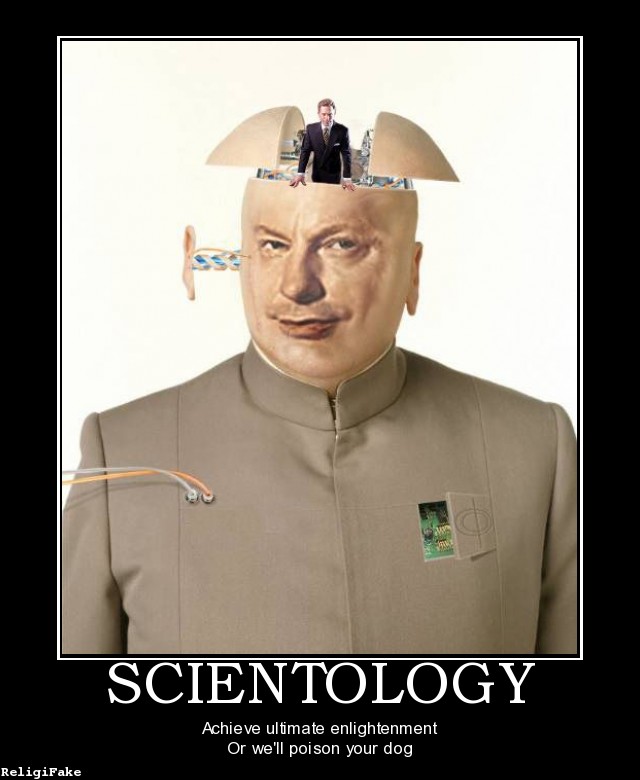
Scientology, like most cults, uses exactly the same brainwashing techniques the narcissist does to recruit and retain its members. Here’s a video I found on the Ex-Scientologist Message Board, where Sam Vaknin talks about the “cult of the narcissist,” and even though it’s not specific to Scientology, it’s spot on in describing the mind games narcissists use to trap their prey (sorry, I was unable to embed the video). The same techniques apply to most cults. Scientology is one of the most dangerous.
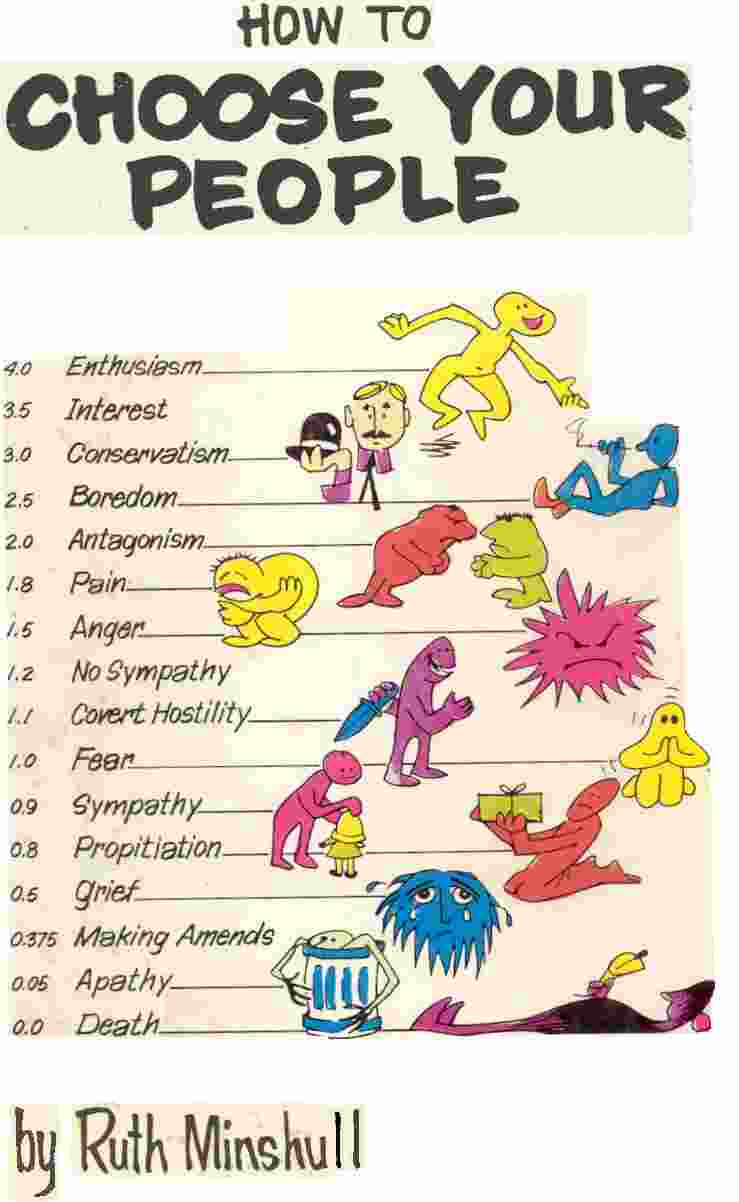
In 1978 and 1979, I flirted with Scientology. This happened when I came across one of its books (one of the only ones not written by its founder L. Ron Hubbard, who was not only a malignant narcissist of the highest order, but also a very bad writer), an easy to read and humorous “self help” book called “How to Choose your People,” by a writer named Ruth Minshull. The book was discontinued many years ago, probably because it wasn’t written by Hubbard and therefore not acceptable “scipture.” “How to Choose Your People” was entertaining and well written, and I found its idea of something called “The Tone Scale” intriguing and it seemed to make sense. I liked the idea that emotions ran on a sort of continuum, with one logically leading to the next. Every human being can be placed somewhere on this “tone scale.” Although most people move around on the scale according to their mood, everyone can be placed at a “home” tone, where they will be most of the time. The “tones” ranged from Apathy (the lowest you could go–this would be where severely depressed and suicidal people are) to Enthusiasm (very happy and contented people). Each tone was assigned an arbitrary number, although no one ever explained what those numbers meant.
There were two “emotions” around the middle of the scale, called Covert Hostility (1.1) and No Sympathy (1.2, making it slightly “better”). Although not at the bottom of the scale, while I was involved in Scientology (and the related Dianetics, the mental “technology” that is similar in some ways to psychoanalysis and serves as a tool to brainwash its members), Covert Hostility and No Sympathy were considered by most Scientologists to be the two worst places to be on the Tone Scale. No one wanted to be labeled a “1.1.” Because if you were, it meant you were a Suppressive Person–that is, a psychopathic person who could harm the Church and its members. If you were pegged a “1.1” or a “1.2” you could be excommunicated or punished by a cruel form of shunning (which I was subjected to at one point).
The traits of someone with a “tone” of Covert Hostility or No Sympathy are exactly the same of those of the malignant narcissist. Here is a picture of the tone scale as it appeared on the cover of Minshull’s 1976 book. (There is an expanded tone scale too, which has additional levels, but for our purposes this one is sufficient).
Click image for larger view.
So I finished Minshull’s book and was intrigued enough to go to the local Scientology Center (on New York’s upper west side–I was living in Queens, NY at the time) and find out more. They gave me a “personality test,” that was supposed to identify what my issues and weak points were. There were 200 questions on the test, but when I was done, someone sat down with me and went over my results and convinced me I needed Dianetics auditing or classes in Scientology (much cheaper than Dianetics auditing) to overcome these weak points. The recruiter was very convincing and friendly, and assured me I would only be set back $15 to sign up for the HAS course (Hubbard Apprentice Scientologist aka “Communication Course”), which was really training in something called Training Routines (TR’s) which were used as brainwashing techniques.
At first the TR’s were very seductive–they were fun and actually seemed to work. They did help me be able to “confront” people better, or at least seemed to. The TR’s themselves involved things like sitting in a chair staring at someone as long as you could without reacting, laughing, or looking away. After this, the ante was upped to something called “bullbaiting,” where the person could try to get you to react and “lose your Confront” by insulting you, trying to make you laugh, or calling you names. There were higher levels of TR’s that involved walking across the room, touching things, asking if birds could fly, and reading passages from “Alice in Wonderland” of all things.
All these things were supposed to help you communicate with others better and raise your “tone,” but in actuality, these were all brainwashing techniques that would eventually result in giving you the infamous blank stare that many Scientologists seem to have while under the cult’s thrall.
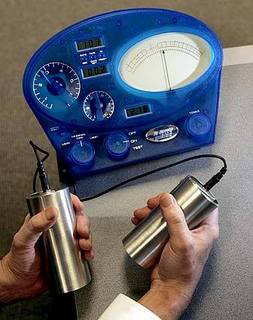
After I “passed” the Communications Course (by getting a “floating needle” on a lie-detector type of device called the E-Meter), I was convinced without too much difficulty to sign up for the next course, the HQS course (Hubbard Qualified Scientologist). That one set me back $250. (The prices are probably much higher today). By this time of course, I’d been sufficiently indoctrinated that $250 for further “processing” and “training” didn’t seem that bad. It didn’t take much to convince me to hand over the money.
In order to help pay for the course (because in those days $250 was a lot of money, especially for a 19 year old) it was suggested I work at the Center part time, answering phones and opening and distributing mail. The position paid nothing, but I got “credits” to help pay for the course. Of course, by now I was spending most of my free time at the Center, because right after “work” it was time for the classes, which ran about 4 hours a night (5 days a week).
Students were closely monitored and every class ended with a session on the E-Meter. If you were caught yawning or daydreaming you were told you had a “misunderstood word” and had to go back and re-read Hubbard’s unreadable material to try to find the word you did not understand. You were not allowed to move on until you found the word and “passed” on the E-Meter. I began to realize I wasn’t having much fun anymore, but if you criticized Scientology or its “teaching technology” in any way, you would be sent to Ethics.
Scientology E-Meter
No one wanted to be sent to Ethics. If you were sent to Ethics, it meant there was a problem and you were considered a “Potential Trouble Source” and disciplinary action would be taken. I was sent to Ethics about three times, all for very minor transgressions such as minor criticism. The punishments ranged from having to re-read material (and be “passed” being connected to an E-Meter), to cutting off friends and family members who could be potential “Suppressive Persons” or enemies of Scientology (you would be required to write them a letter telling them you were cutting them off), to shunning, to excommunication.
I was once subjected to shunning. I was told although I would still be required to fulfill my job duties and attend classes, no one would be allowed to speak to me and I was allowed to speak to no one (unless it was directly related to my job or something I was learning). It was horrible. This torment on for several days, until I was “passed” up a level and allowed to be spoken to again. But before that could happen, I had to go up to every high level member and employee, make amends to them and “re-introduce” myself.
Toward the end of the HQS course, you are told to recruit other people into Scientology. I had to go outside, no matter what the weather, and try to talk people into coming up to the Center to take its personality test. The more advanced TR’s taught in this class became increasingly bizarre. These sessions could go on for hours, and as part of the training, I was also required to “audit” other students and conduct TR’s on them. If they proved difficult or uncooperative, I was the one who was blamed and was not allowed to stop “running the TR’s” until my student had passed on the E-Meter. If it went on all night, then so it did. You were not allowed breaks to eat or rest, and neither was your student. I remember once being so exhausted from lack of sleep and hunger that I burst into tears in the middle of running a session, and was immediately sent to Ethics and that’s how I got the “shunning” punishment. I was stunned by their total lack of empathy.
I thought about leaving, but didn’t dare–because they threatened you with something called “Fair Game.” No one ever explained exactly what that was, but in Hubbard’s indecipherable scripture, “fair game” appeared to imply the Church reserved the right to stalk you, torment or even kill you if you “blew” (left). I’d also paid so much money into it by this point and spent so much time with them that I was hesitant to toss in the towel.
Shortly before I was to graduate from HQS (which I never did finish), I was sent to talk to a recruiter about my next “step up the bridge.” I was told I should sign up for “Life Repair,” which cost $6K. I told the recruiter I did not have that kind of money. The recruiter turned to the hard sell at that point. He told me to get a bank loan or ask my parents for the money. Neither was possible. There was no way I could pay back the bank, as my other (paying) job was part time and paid only $2.75 an hour (minimum wage at that time), and my parents were not the type to hand over large sums of money, even for something legitimate.
Finally, after two hours of unsuccessfully trying to get me to sign up for this $6,000 auditing package, the recruiter gave up and was quite hostile to me after that. He not only told me that I must not really be interested in moving up the Bridge, but that I was probably a Suppressive Person and an enemy of Scientology because I would not put myself in huge debt to continue to be brainwashed.
It was at this point I left the Church. I just didn’t care anymore. I had gradually come to realize that the “emotional tone” of the organization was somewhere around Covert Hostility and No Sympathy–which was quite interesting since those were the tones that were the most hated and feared and were the realm of the dreaded Suppressive Person. In other words, Scientology was a psychopathic, narcissistic cult, founded by a psychopathic malignant narcissist (1.1 on his own Tone Scale) whose ravings (and fabrications as a “war hero” among other things) are legendary. What they were really doing was projecting their own emotional tone (malignant narcissism) onto those who disagreed with them.
I also realized how I had been gradually seduced into this psychopathic organization through misrepresentation, manipulation, threats and lies. The personality test and the inexpensive and fun HAS course that promised to help me feel happier and more confident was merely the “love bombing” phase before the abuse that would come later and increase over time. I did NOT want to become one of the upper-level Scientologists, with their blank, weird stares, creepy smiles and total lack of empathy. Just look at Tom Cruise today: does he even seem human anymore? Hell, I’d rather be a Suppressive Person any day than one of them.
I didn’t get nearly as far up the “Bridge” as many other people, and therefore did not experience some of the trauma and torture inflicted on members who are more deeply enmeshed with this psychopathic cult. Eventually they WILL take over your entire life. For anyone interested in finding out more about the evil mindgames this cult plays, its psychopathic paranoia about both government agencies like the IRS and its hatred and fear of traditional psychotherapy and psychiatry, and the horrific (and sometimes fatal) punishments inflicted on many of its members and their families, I highly recommend either of these two websites that call out Scientology for what it really is.
The Ex-Scientologist Message Board: http://www.forum.exscn.net/ (This is where I found the Sam Vaknin video posted at the beginning of this article).
Operation Clambake: The Inner Secrets of Scientology: http://www.xenu.net/
Gotta love the adoring look on Lidija’s face (but why is she sitting so far away from him?). Click for closer view.
Let’s face it. In reviewing my stats and my WordPress “annual report,” it’s obvious my Sam Vaknin articles get the most views and are the most popular and the most shared (“My Son is Furry-Got a Problem with That?” is still in the second place spot though, oddly enough–I wrote that back in September and it still is one of my most popular and shared articles).
So here’s another Sam Vaknin article for all you Sam Vaknin buffs out there (and to feed Sam’s narcissistic supply, of course–the strong possibility of him pimping anything I write about him on social media helps this blog too).
Being that I find Sam a rather endlessly fascinating character (as many people seem to), I don’t have a problem with posting something else about Everyone’s Favorite Narcissist. Especially when it’s an interview with The Narcissist Himself and His Wife.
This one was on DrPsychMom’s (Samantha Rodman) website. In it, she questions Sam (and Lidija) about their marriage and things such as what Sam expects from his wife and what she’s willing to give (seemingly everything), and whether or not he engages in narcissistic games like gaslighting and projection. It seems her unconditional kindness and patience (I swear, this woman is a saint) serves as a sort of monitoring device for him, keeping him from derailing into narcissistic fury, and I suppose she finds him and the life he leads exciting and his mind fascinating (even though it’s hinted that they don’t have sex). As for love, well, what Sam feels for Lidija is probably as close to love as a narcissist can ever feel, and she is clearly smitten with him. He admits the fact they were both abused by their mothers created a bond between them. Though having similar backgrounds, Lidija is anything but a narcissist, or she is what some psychologists now call an “inverted narcissist,” which is a codependent, nurturing type of person who is most attracted to narcissists who use them as a constant source of supply.
The bits posted in red are DrPsychMom’s wry and frequently funny observations and comments.
During this interview, the irascible, easily irritated Sam frequently becomes annoyed, which you might expect when a famous narcissist is questioned about his private behavior at home and how his wife reacts to it.
I have not yet finished Sam’s tome about NPD (it is VERY long but so far readable enough), so I cannot write a review of it myself (but I definitely will when I finish the book).
In the meanwhile, I came across this fascinating interview that sheds some light on Sam’s motivations for writing “Malignant Self-Love,” something I’ve wondered about almost obsessively ever since I saw “I, Psychopath” on Youtube over two months ago. Hey, we Aspies tend to obsess about things!
It’s an excerpt from a longer article by Tony C. Brown I found on FriedGreenTomatoes.org, another website for survivors of narcissistic abuse. The article itself is biased from the the side of Sam’s detractors (which goes into lengthy diatribe about Sam’s ever-discussed “fake degree”), but trashing his true motives or his credentials (which I don’t care about) isn’t my desire or my point in excerpting this interview. I think Sam is being as brutally honest about himself here as he appears to always be.
The best insight I have found for understanding Sam’s intentions in writing “Malignant Self Love” came in an interview Bob Goodman conducted with Mr. Vaknin and was published on the Natterbox website in 2000. The following exchange helped me develop a better understanding of Mr. Vaknin’s motives and agenda.
Bob Goodman asks , “I’ve seen Malignant Self Love described in some contexts as a self-help book. Often in this genre, we see authors who have triumphed over some personal adversity and wish to help others do the same. But your approach is quite different. You write that your discovery of your own NPD “was a painful process which led nowhere. I am no different — and no healthier — today than I was when I wrote this book. My disorder is here to stay, the prognosis poor and alarming.” Do you see the book, then, as more a work of self-literacy than self-healing?”
Mr Vaknin replies, “I never described Malignant Self Love as a helpful work. It is not. It is a dark, hopeless tome. Narcissists have no horizons, they are doomed by their own history, by their successful adaptation to abnormal circumstances and by the uncompromising nature of their defense mechanisms. My book is a scientific observation of the beast, coupled with an effort to salvage its victims. Narcissists are absent-minded sadists and they victimize everyone around them. Those in contact with them need guidance and help. Malignant Self Love is a phenomenology of the predator on the one hand, and a vindication and validation of its prey on the other.”
Mr. Goodman: “You are a self-professed narcissist, and you warn your readers that narcissists are punishing, pathological, and not to be trusted. Yet hundreds of readers or customers seem to be looking to you for help and advice on how to cope with their own narcissism or their relationship with a narcissist. I’m struck by a kind of hall-of-mirrors effect here. How do you reconcile these seeming contradictions?”
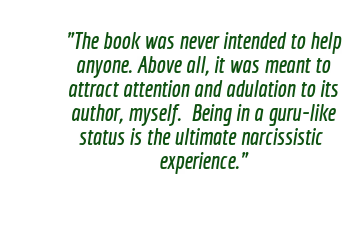
Mr. Vaknin: “Indeed, only seeming. I may have misphrased myself. By “helpful” I meant “intended to help.” The book was never intended to help anyone. Above all, it was meant to attract attention and adulation (narcissistic supply) to its author, myself. Being in a guru-like status is the ultimate narcissistic experience. Had I not also been a misanthrope and a schizoid, I might have actually enjoyed it. The book is imbued with an acerbic and vitriolic self-hatred, replete with diatribes and jeremiads and glaring warnings regarding narcissists and their despicable behavior. I refused to be “politically correct” and call the narcissist “other-challenged.” Yet, I am a narcissist and the book is, therefore, a self-directed “J’accuse.” This satisfies the enfant terrible in me, the part of me that seeks to be despised, abhorred, derided and, ultimately, punished by society at large.”
One last bit of the interview with Goodman appears toward the end of the article.
Sam lives a nomad lifestyle which he describes in the interview with Bob Goodman.
Mr. Goodman asks, “I understand you’re something of a nomad now, hopping from country to country and job to job. Do you ever long for a more settled existence?”
Sam replies, “Never. You are describing a morgue, a cemetery. My life is colorful, adventurous, impossible, cinematic. Sure, I pay a price — who doesn’t? Is there no price to be for a sedentary, predictable, numbing existence? When one is 90 years old, all that is left is memories. You are the director of the movie of your life, a 70 years-long movie. Now, sit back and begin to watch: is it a boring film? would you have watched it had it not been yours? If the answers are negative and positive, respectively, you succeeded to live well, regardless of the price you paid.”







 Lucky Otters Haven