
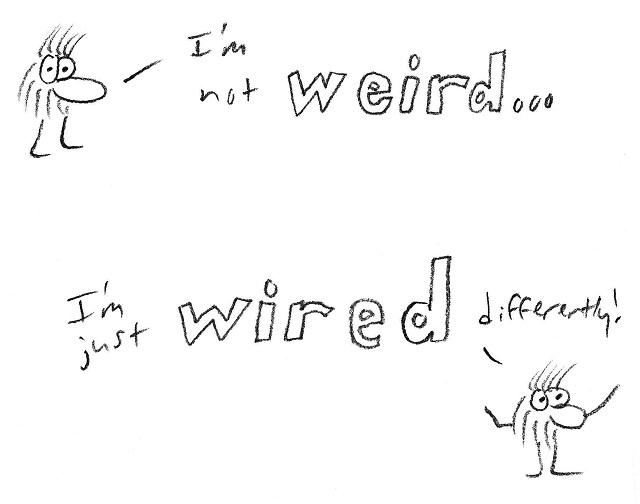
At the time I wrote this post, I thought I had Aspergers. I don’t. But I still think this is good advice if you do or even if you don’t. It could get you out of a lot of awkward situations.
Most neurotypicals don’t get Aspies. Although there’s a certain cachet now for Aspies on the Internet (because so many of us feel more at home online than in the real world), in the neurotypical world, we’re still socially awkward oddballs who don’t fit in.
I noticed if I say nothing about having this disorder, people tend to treat me like I’m stupid, snobbish, or annoying, or sometimes all three! As Rodney Dangerfield (who probably didn’t have Aspergers) used to say, “I can’t get no respect!”
On top of my Aspergers, I’m also avoidant — AND I have hearing issues. As a child, I had a lot of ear infections so I have only 10-20% hearing in my left ear. My Avoidant personality and hearing deficit both tend to exacerbate my Aspie traits, so when it comes to being able to interact normally in a social setting, I just plain suck at it. I usually just stay quiet but people still think I’m probably a cold and unfriendly person, if not stupid.

I didn’t make this graph but it made me laugh.
I found a sort of solution to this problem, and found that it does improve the way people treat me. It’s a very simple solution. I TELL people I have Aspergers (and hearing problems). No further explanation is generally required. If they know in advance that my brain is differently wired and keeps me from reading social cues well and that I also don’t hear very well (from my left side), then they tend to be more patient and become less annoyed at me for asking them to repeat things, saying something awkward, or saying nothing at all.
At first it embarrassed me to tell near-strangers that I have a mental disorder differently wired brain (I don’t tell them about the Avoidant PD–it’s not necessary and no one know what it is anyway), but it’s a lot less embarrassing than being thought of as an idiot, a snob, or an annoying person. Doing this gets easier over time. Now, telling someone I barely know I have Aspergers and can’t hear well out of my left ear feels no weirder than telling them I don’t care for shellfish. And it’s usually met with a knowing “Ah, okay then.”
There’s an additional benefit too. If someone doesn’t know much about what Aspergers is, it gives me the opportunity to tell them. Since it’s something I know a lot about, and I like to talk about psychology anyway, telling people I have Aspergers acts as a sort of icebreaker. It disarms them, and sometimes they share something personal with me.
 Lucky Otters Haven