
Narcissists infect people, just like a disease. They have the uncanny ability of turning people into one of them, if you’re around them long enough. That’s why, whenever it’s possible, No Contact is always the best course of action. You cannot change a narcissist or reform them. What will happen instead is you will start to take on narcissistic behaviors yourself.
Narcissists are body-snatchers and will snatch yours and before you know it, you can become one of them. It may be the only personality disorder that’s contagious. Hanging around one too long is very dangerous to your self esteem, your identity, and even your soul. It’s more dangerous than making your escape, even if you don’t have a dollar to your name.
If you were raised by them, you may have a serious problem. Many (though not all) children of narcissists become narcissists or borderlines themselves. Because narcissistic parents can’t form proper bonds with their children and either use them as supply or scapegoats, children of narcissists more likely than not develop severe attachment disorders in childhood, and attachment disorders can easily become NPD, either covert or overt, somatic or cerebral. If the child is a little luckier, she or he can develop BPD, PTSD and many other disorders that make adult life difficult.

Overt/classic/grandiose narcissism (the type that best fits the criteria in the current DSM) develops most often in golden children who were held on a pedestal and could do no wrong, or were terribly spoiled, or it can develop in child who served as the parent’s flying monkey. It can also develop in a scapegoat who wants to prove their narcissistic parents wrong. Overt narcissists are usually extroverts who are good at playing the role of a confident, aggressive leader and many of them become financially and professionally successful. They are good at maintaining their mask for as long as they need to.
Covert/vulnerable narcissism usually develops in a scapegoated child who cloaks their grandiosity in an outer cloak of deference and humility, usually as a way to avoid punishment for acting too arrogant or aggressive while growing up. It can also develop in a child who is sometimes a scapegoat and sometimes a golden child. In a way, they are worse off than an overt narcissist, because they have a double layer of masks (false selves): the grandiose mask that hides the undeveloped, atrophied true self within, and a meek, shy and deferent outer mask that cloaks their grandiosity and sense of entitlement. That’s why a covert narcissist can be easily pushed around or bullied by others, but underneath their seemingly nice, quiet image there is seething envy and anger that isn’t expressed unless they are pushed to the limit and explode in rage. Their rage and envy is also likely to come out in passive-aggressive ways. Yet a covert narcissist is easier to cure because (a) they are far more likely to want help; and (b) their lives are miserable and their brand of narcissism isn’t adaptive in today’s world.
BPD is more common in women and some female covert narcissists may actually be diagnosed with BPD, because the disorders can seem so much alike and women aren’t diagnosed with NPD as often as men are. BPD probably develops most often when there is ambiguous attachment to the mother during early childhood and the child is inconsistently rewarded and punished. They learn early that people and life are unpredictable and no one can be trusted. They fear abandonment because they were never able to tell if their parent would love them or push them away. BPD also is correlated with early sexual abuse.
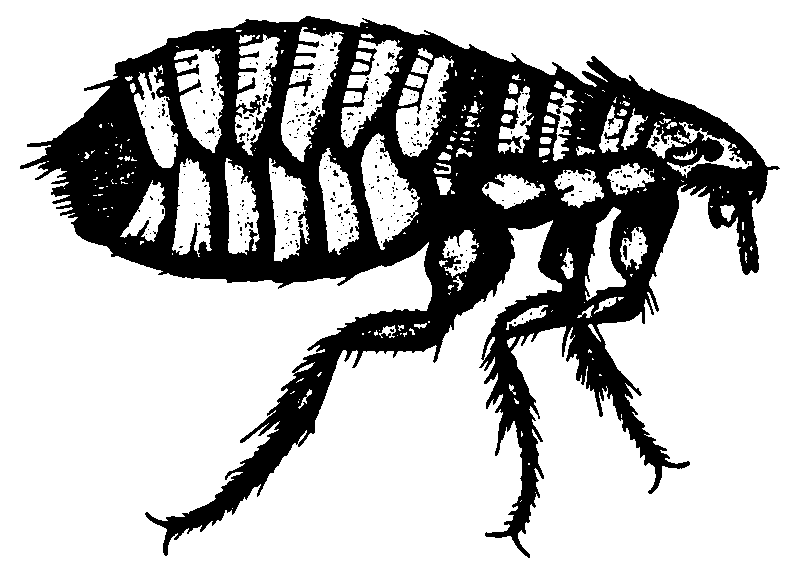
Fleas of narcissism are deadly because with prolonged exposure, they can cause permanent infestation. If it’s at all possible, cut off any narcissist in your life or avoid them as much as possible. Watch for red flags so you can escape before it’s too late because escaping once they “have” you is far more difficult and can be dangerous.
If you were raised by narcissists, no matter how damaged you are, if you didn’t become a narcissist yourself, consider yourself extremely lucky. There is hope for you to eventually be able to live a normal, happy life. If you’re a non-malignant narcissist, there may still be hope but the road to becoming a normal and happy person is going to be longer and harder.
 Lucky Otters Haven
Great posting;.
LikeLiked by 1 person
🙂
LikeLike
Thank you for this post. I have been dealing with some very nasty flea bites. In your post, I recognized the poisonous effect those fleas have had on me.
LikeLiked by 2 people
‘Fleas’ – that’s a great term, and one I use often when referring to my own ‘Mommie Dearest.’ She is a narcissistic borderline and was an unreasonable neat-freak with me, in particular, when I still lived at home. I developed some OCD traits that I have gotten rid of over the years. The only way to deal with her was to cut off all communication. I haven’t spoken with her in 5 years, and feel much better for it.
🙂
LikeLiked by 1 person